
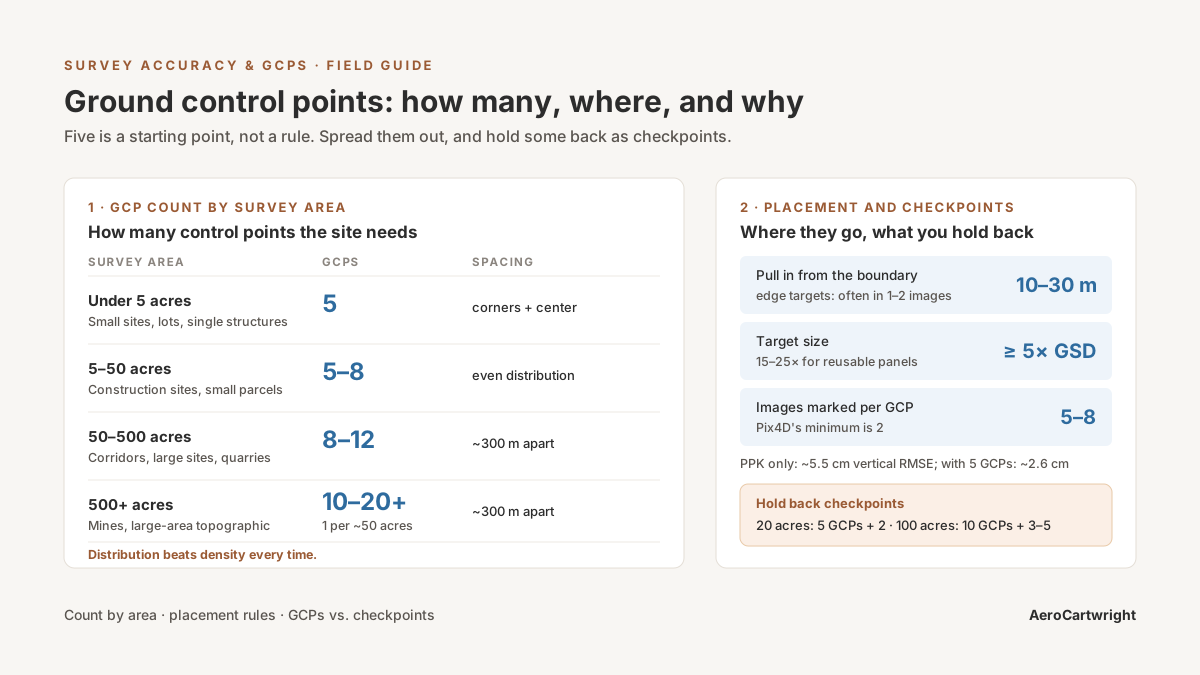
Ground Control Points for Drone Surveys: How Many, Where, and Why
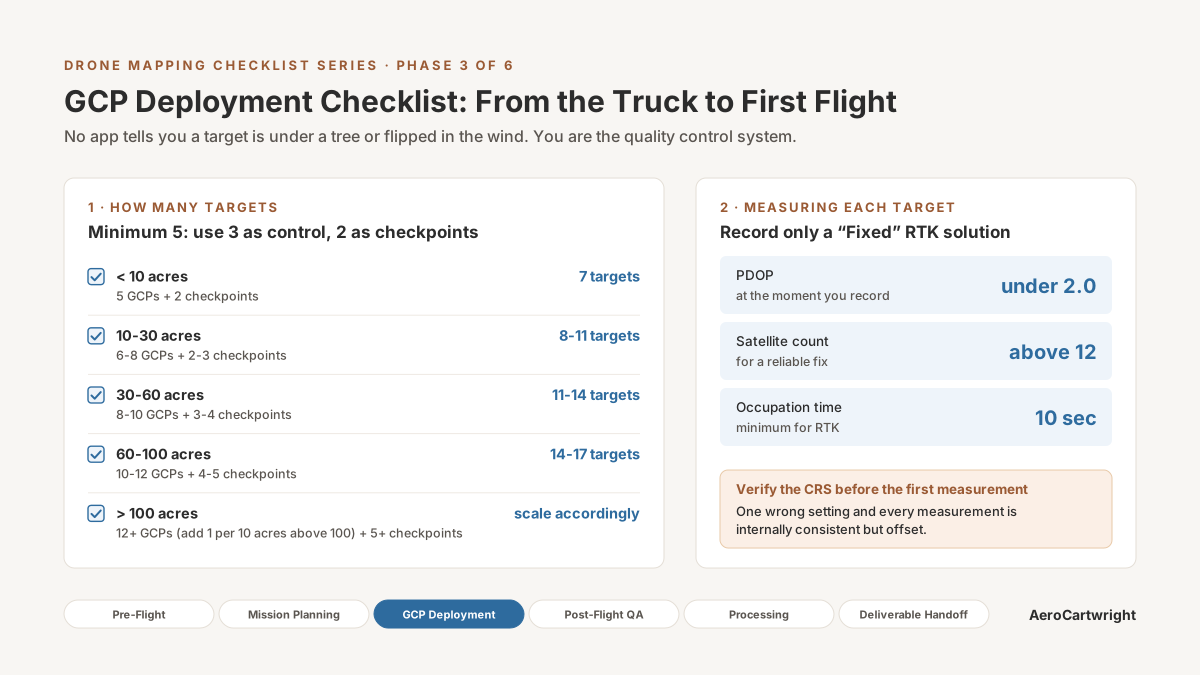
How many ground control points does a drone survey need? 5 GCPs for under 5 acres, 8–12 for 50–500. Distribution beats density — and always include independent checkpoints.
AeroCartwright
A reference collection on drone mapping, photogrammetry, LiDAR workflows, and geospatial data processing. Written by a GIS scientist with M.S. GIS, FAA Part 107, and 10+ years of field experience.
In Progress
Each series is a structured body of work on a single subject — published in order, with future articles already scoped. Pick a thread and read it through, or jump in at whatever index matches your skill level.
Series
Aviation checklist methodology applied to drone mapping — the discipline that keeps real survey work defensible. Seven phases from mission planning through deliverable handoff.
Mostly published. Final phase publishing soon.
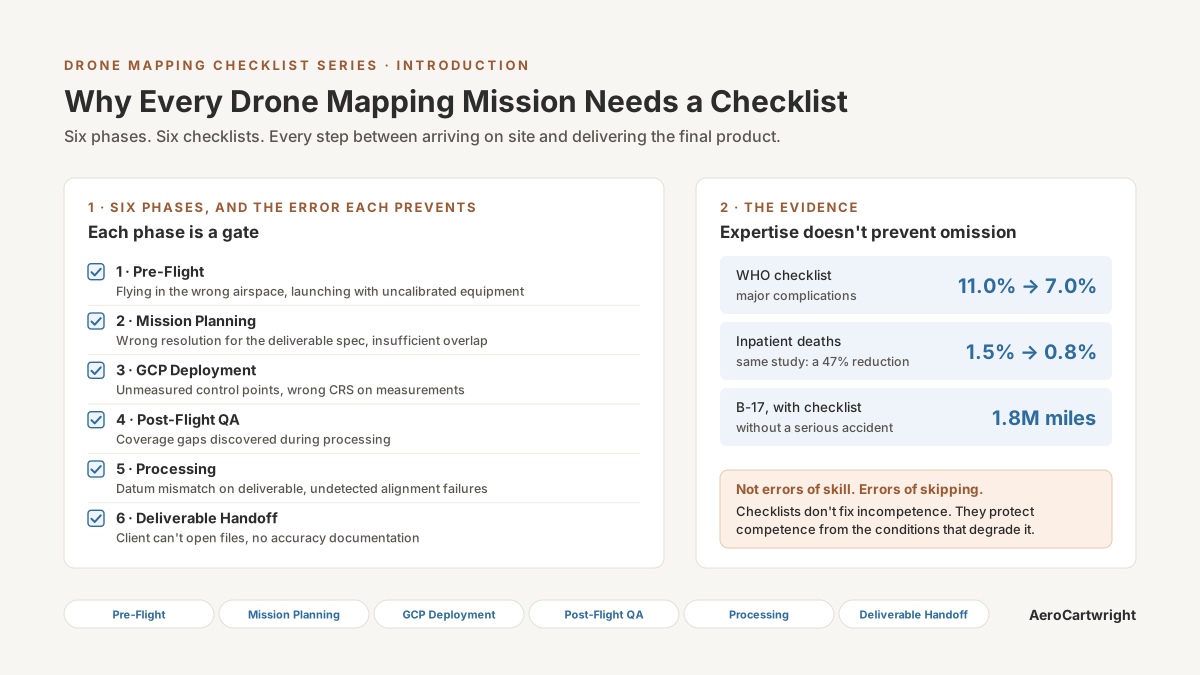
Six-phase drone mapping checklist from pre-flight to deliverable handoff. Based on aviation protocols — prevents costly reflys and data rejection.
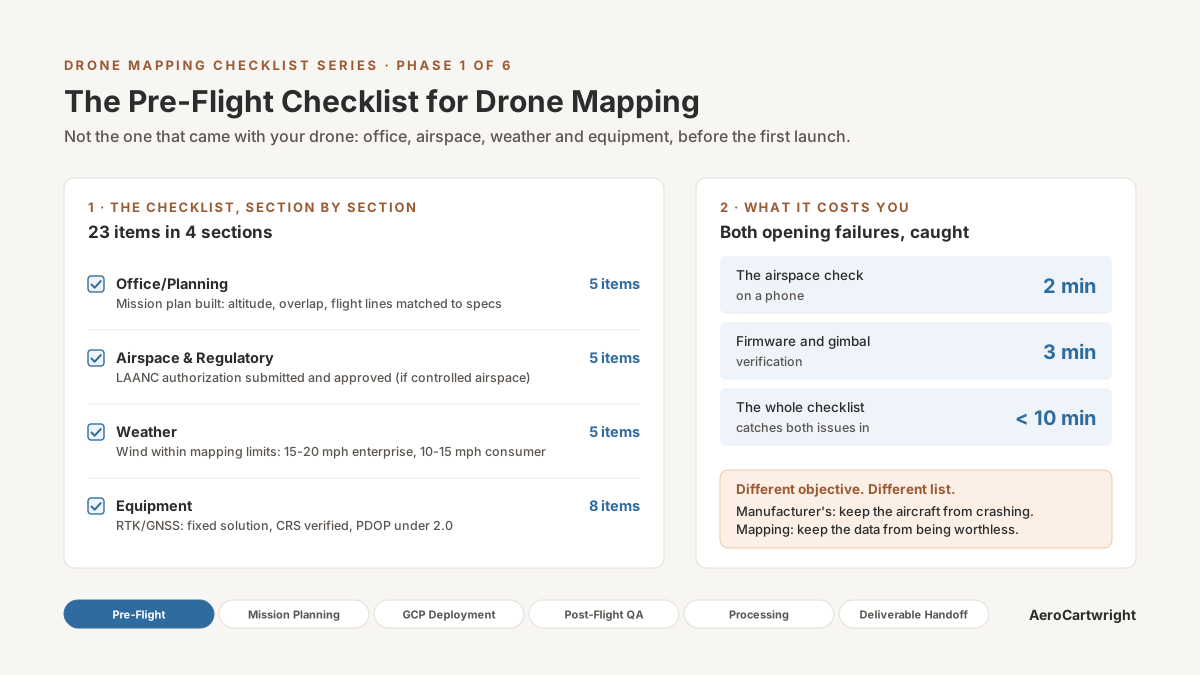
Pre-flight checklist for drone surveys: airspace verification, weather assessment, equipment inspection. Part 1 of the 7-phase drone mapping checklist series.
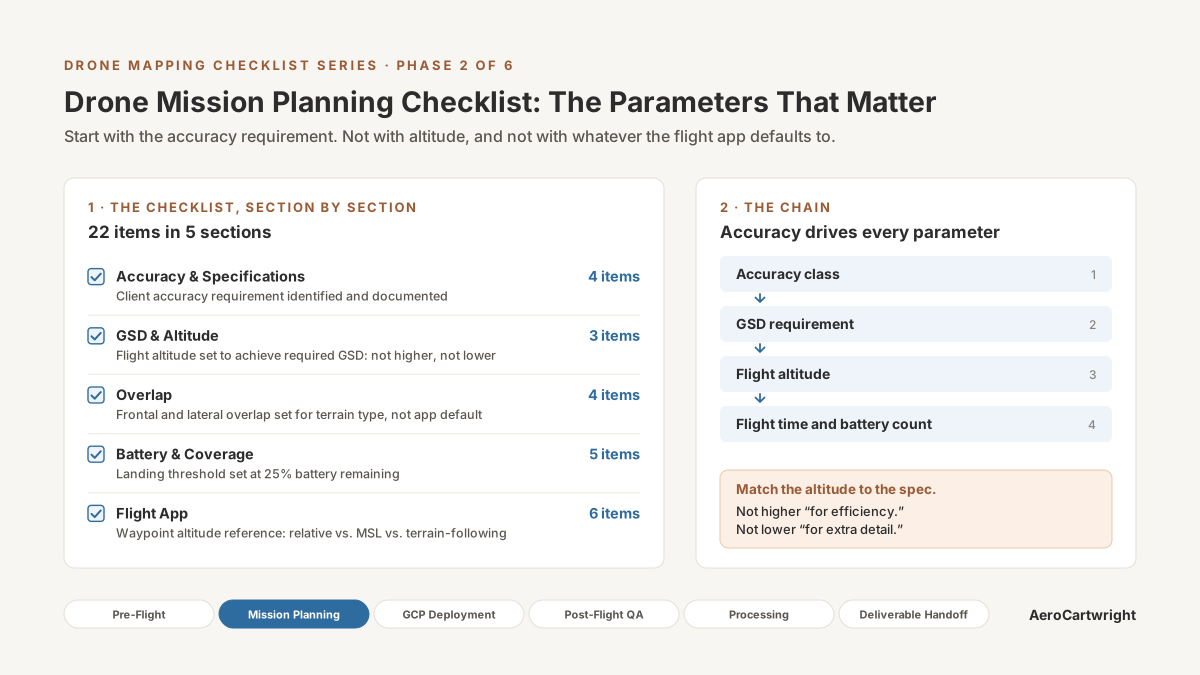
Altitude, GSD, overlap, battery budget — the four parameters that decide whether drone mapping data is usable. Mission planning checklist for surveyors.
GCP deployment checklist: placement, measurement procedure, photo documentation, field logging. Every step from planning through pre-flight.
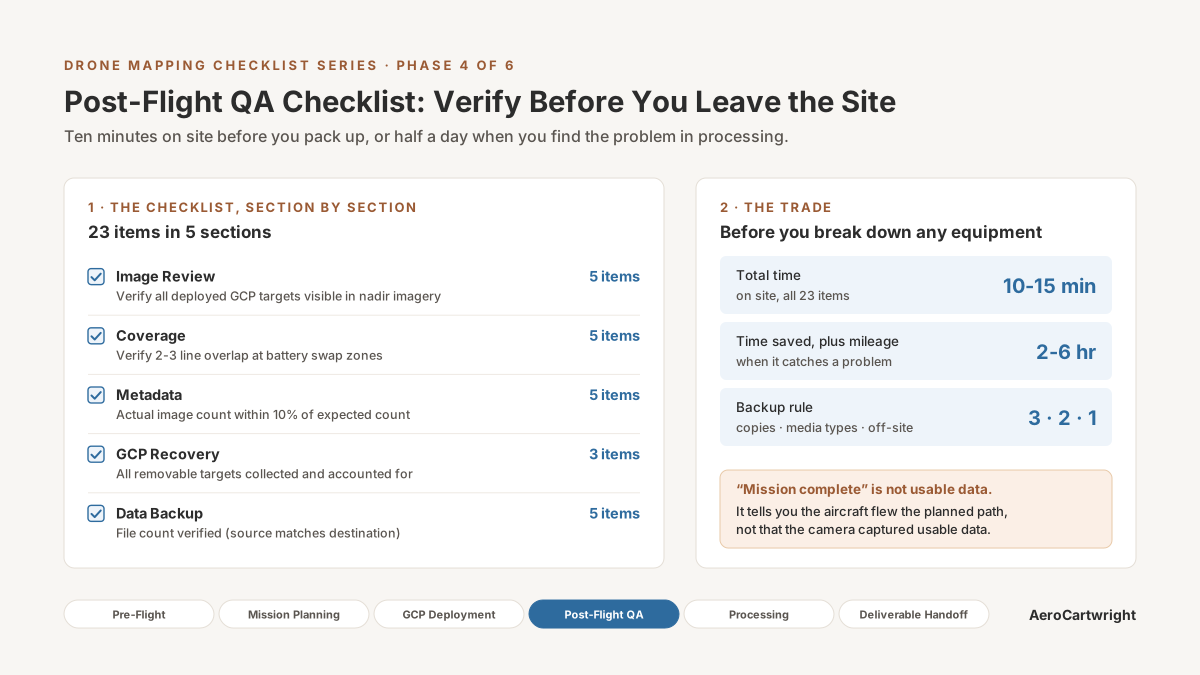
Post-flight QA checklist: image review, coverage verification, metadata validation, 3-2-1 backup. Part 4 of the drone mapping checklist series.
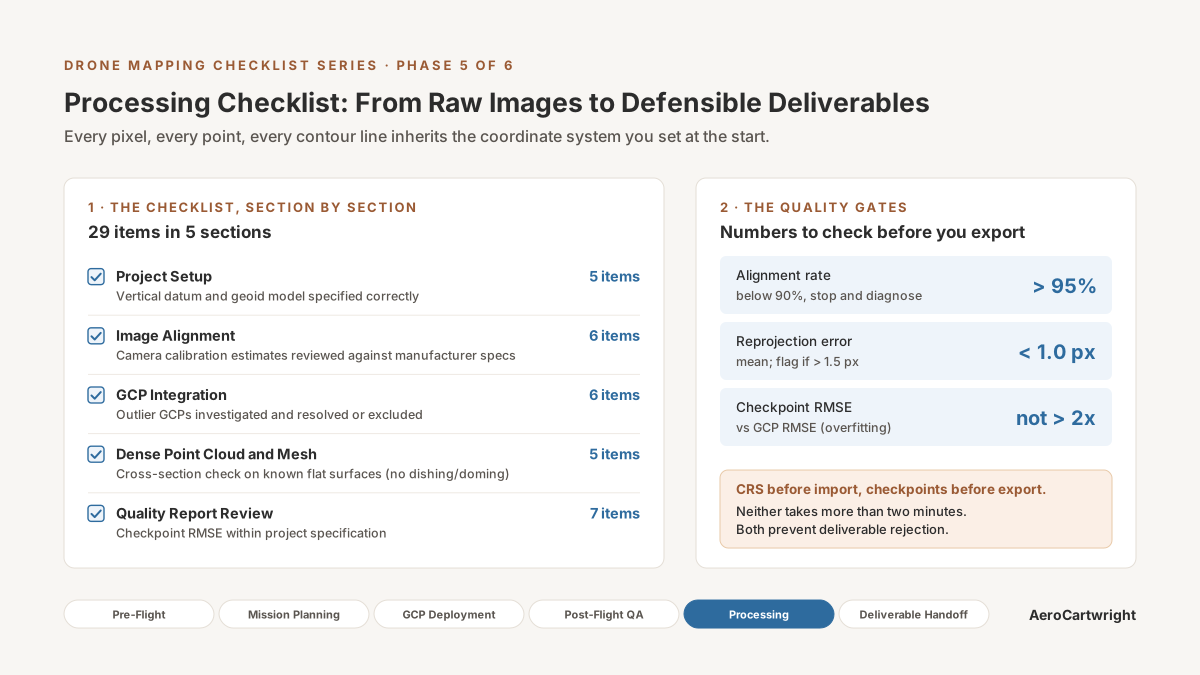
Drone processing checklist: CRS setup, alignment QA, GCP integration, checkpoint validation, quality report review. Prevents accuracy failures.
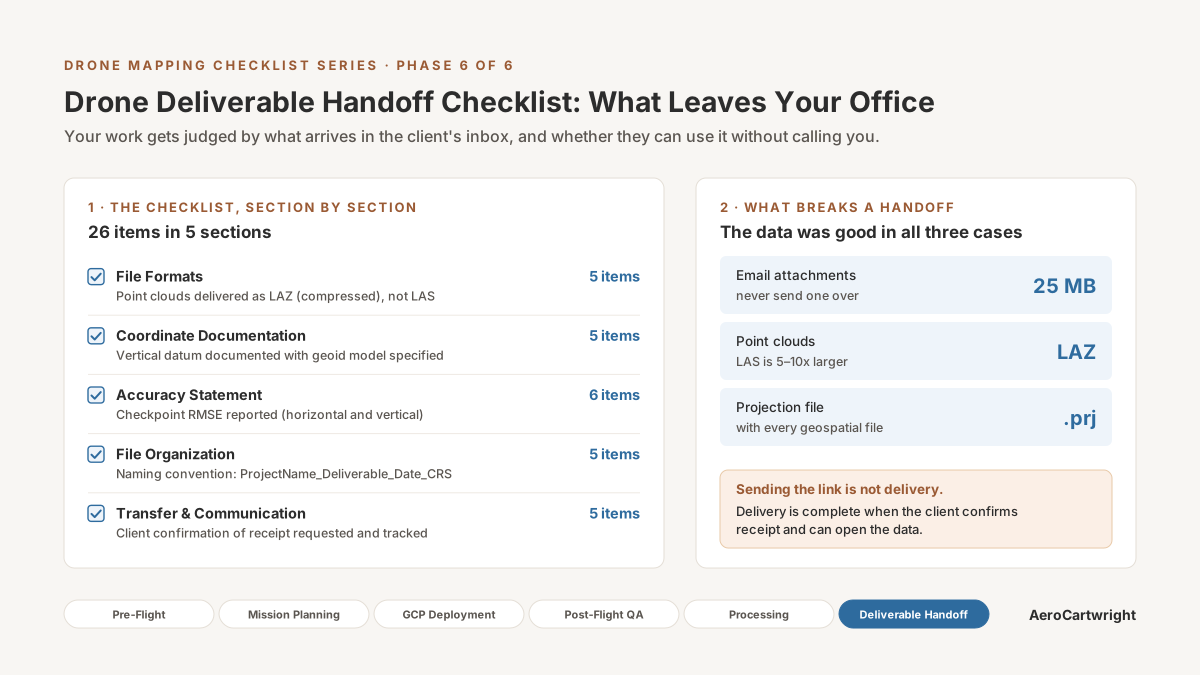
Drone mapping deliverable handoff: file formats, CRS documentation, accuracy statements, client communication. Part 6 of the checklist series.
Series
Mini-4-Pro–class mapping for budget-constrained professionals, freelancers, and serious hobbyists. From first orthomosaic through running a paid practice.
Publishing weekly. New articles every Tue / Thu.
FAA regulates the flight, states regulate the data. Learn where drone mapping crosses into surveying law, which states enforce, and the safe business model.
Fly a grid mission with a consumer drone, process a georeferenced orthomosaic in WebODM within 90 minutes. No GCPs, no survey gear, no paid software.
DJI Mini 4 Pro surveying accuracy: ±6-16 ft GPS-only, ±4-12 in with DIY GCPs, ±0.5-1.2 in with surveyed GCPs. Consumer vs enterprise mapping drones.
Set up GCPs without a surveyor. DIY target construction, budget-to-RTK measurement equipment, the accuracy each tier really delivers, and field procedures that work.
Drone mapping flight parameters: GSD, overlap, altitude, speed. 80% frontal / 70% side minimums, and why 60% frontal overlap is too low for mapping.
WaypointMap vs Litchi Pilot vs DroneLink vs DJI Fly for automated Mini 4 Pro missions. KMZ workflow for RC 2, MSDK apps for Android.
WebODM (free) vs Pix4D ($399/mo) for consumer drone mapping: real cost math, WebODM Lightning pricing, orthomosaic quality, and when each is worth it in 2026.
Series
Deploy WebODM / OpenDroneMap on AWS spot instances. Cloud-scale photogrammetry at single-digit dollar cost per project, with the security and recovery practices that make it production-grade.
Rolling out Jul–Aug 2026.
WebODM and OpenDroneMap are now separate projects. ODX, NodeODX, ClusterODX, ODM and NodeODM explained: what each does, which you need, and how WebODM compares to Pix4D.
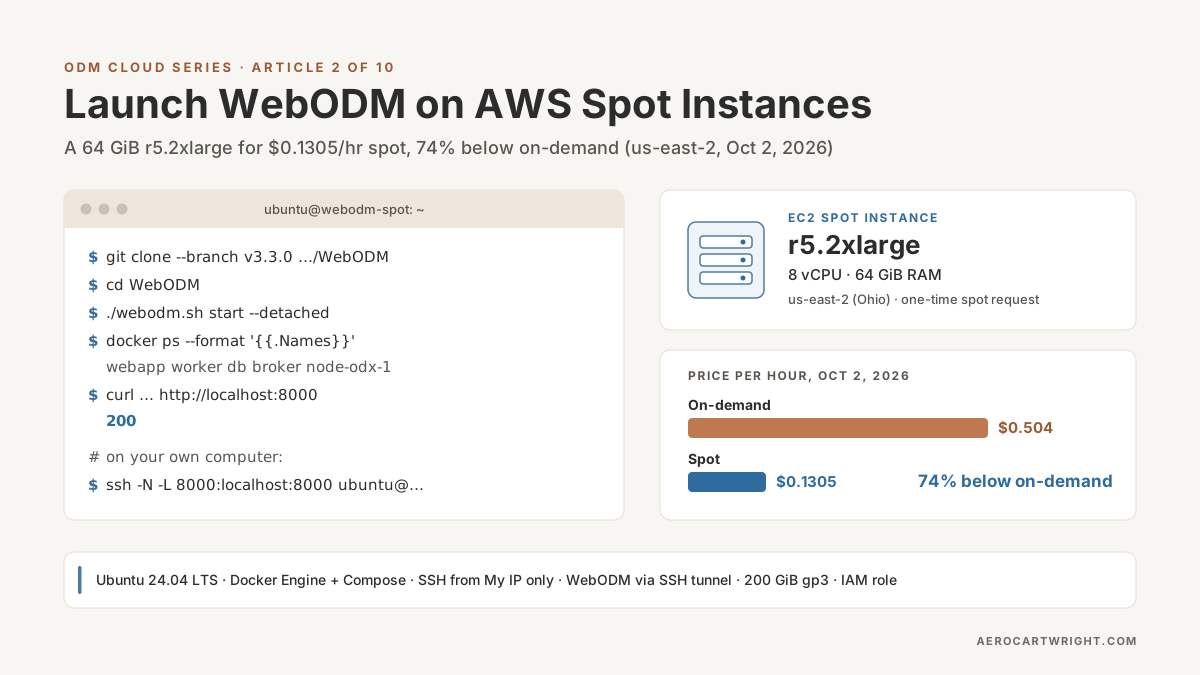
Rent a 64 GB cloud server for about $0.13/hour. Launch an AWS EC2 spot instance, install WebODM 3.3.0, and process 500 images for under $1 before downloads.
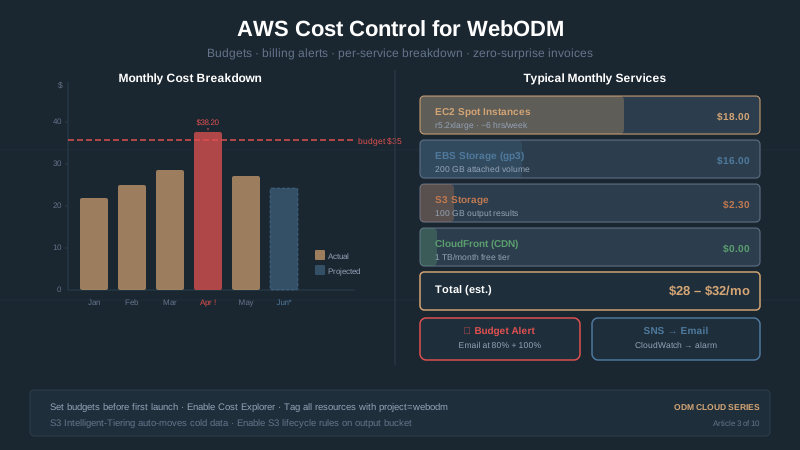
Your first AWS bill says $47.23 when you expected $3. What happened, why egress dominates, and three simple practices to prevent bill shock.
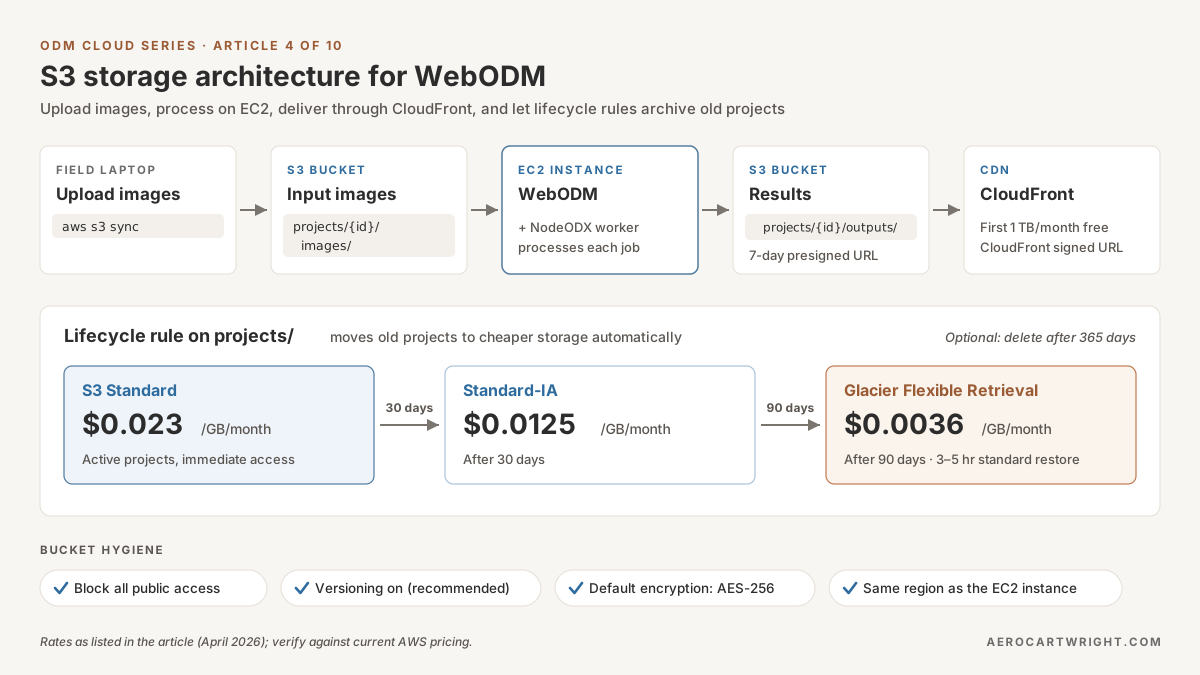
Organize drone images in S3 for WebODM: folder structure, presigned URLs for client delivery, lifecycle policies to control storage costs. CLI included.
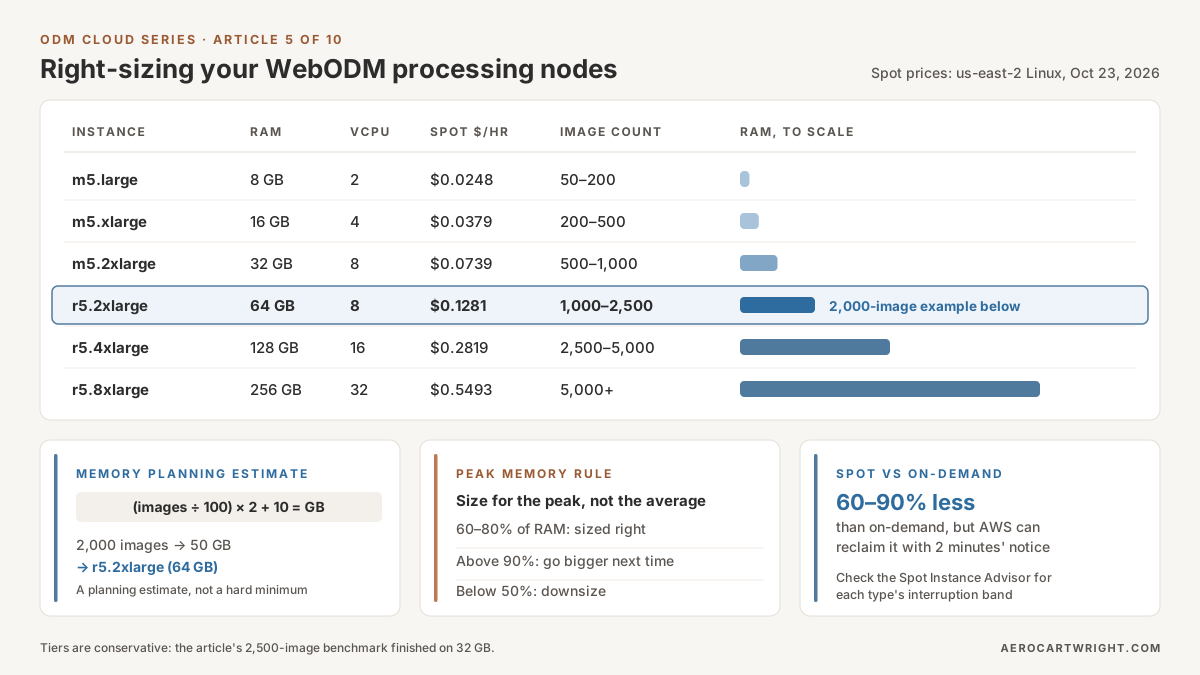
Match AWS EC2 instances to your WebODM image count. RAM is the binding constraint, not CPU. ClusterODX sizing, spot vs on-demand, GPU realities.
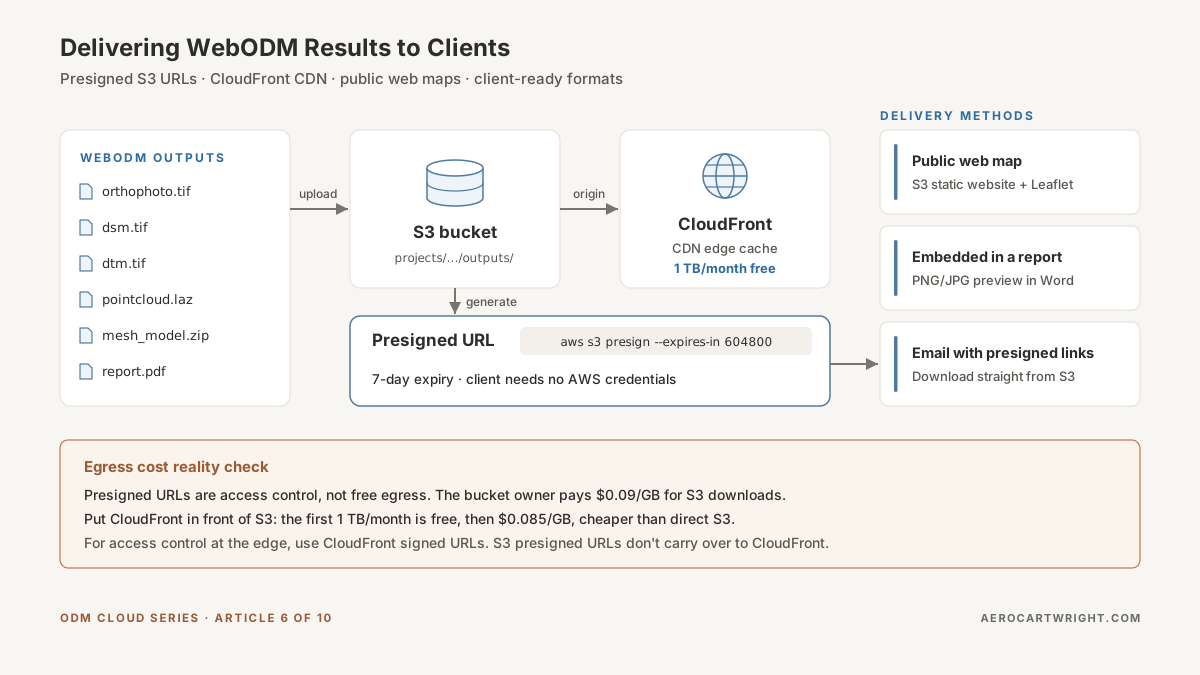
Share WebODM results: S3 presigned URLs, CloudFront CDN, static map hosting, GeoTIFF vs KMZ vs PDF formats, embedding orthomosaics in reports.
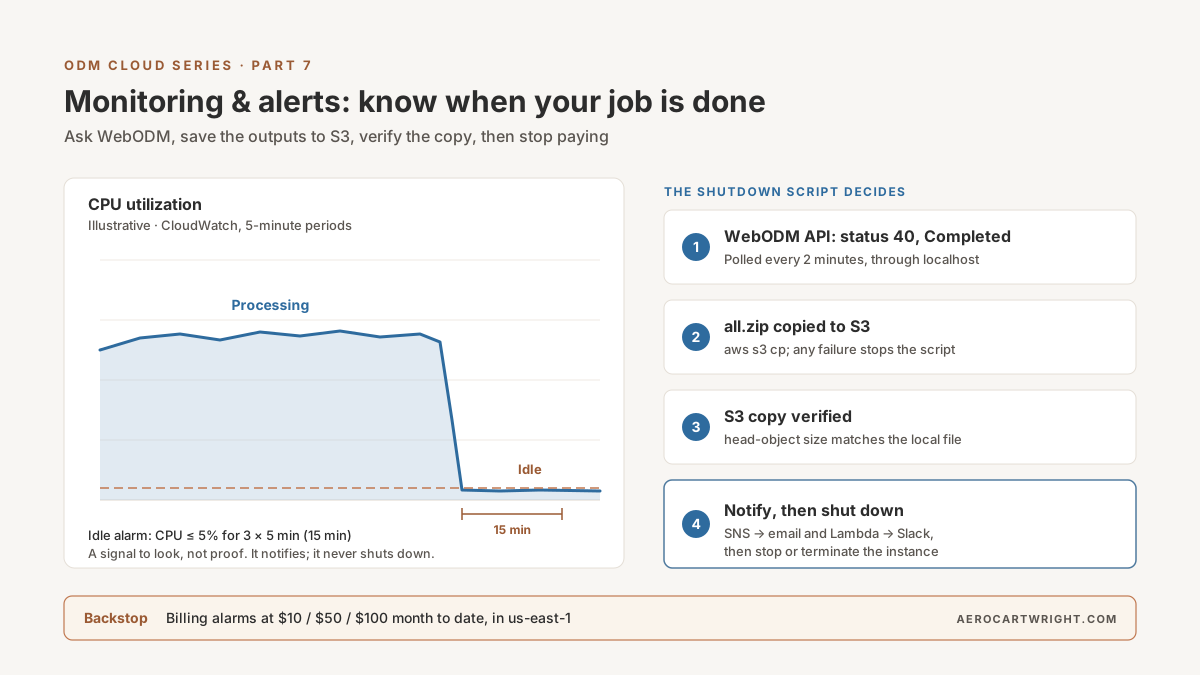
Know when WebODM processing finishes: CloudWatch alarms, us-east-1 billing alarms, SNS email, WebODM API polling, a save-to-S3-then-shutdown script, Slack via Lambda.
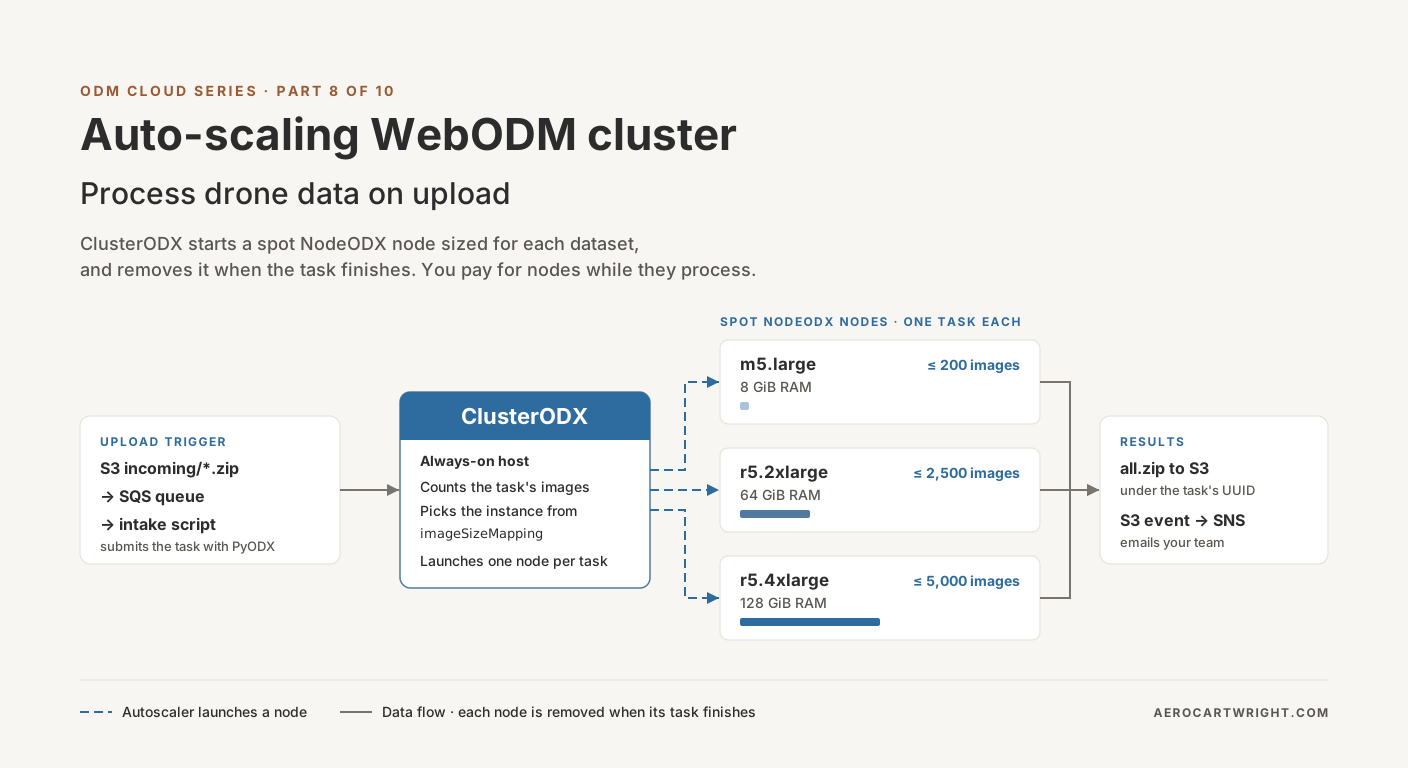
Auto-scale ODX processing on AWS with ClusterODX (WebODM's fork of ClusterODM for NodeODX): image-count instance sizing, split-merge, an S3-to-SQS upload trigger, spot nodes and least-privilege IAM.
Evergreen
Standalone articles outside the named series — the reference material you reach for when you need to look one specific thing up.
How accurate the survey actually is — RMSE, ground control, checkpoints, RTK and PPK, coordinate systems.
How many ground control points does a drone survey need? 5 GCPs for under 5 acres, 8–12 for 50–500. Distribution beats density — and always include independent checkpoints.
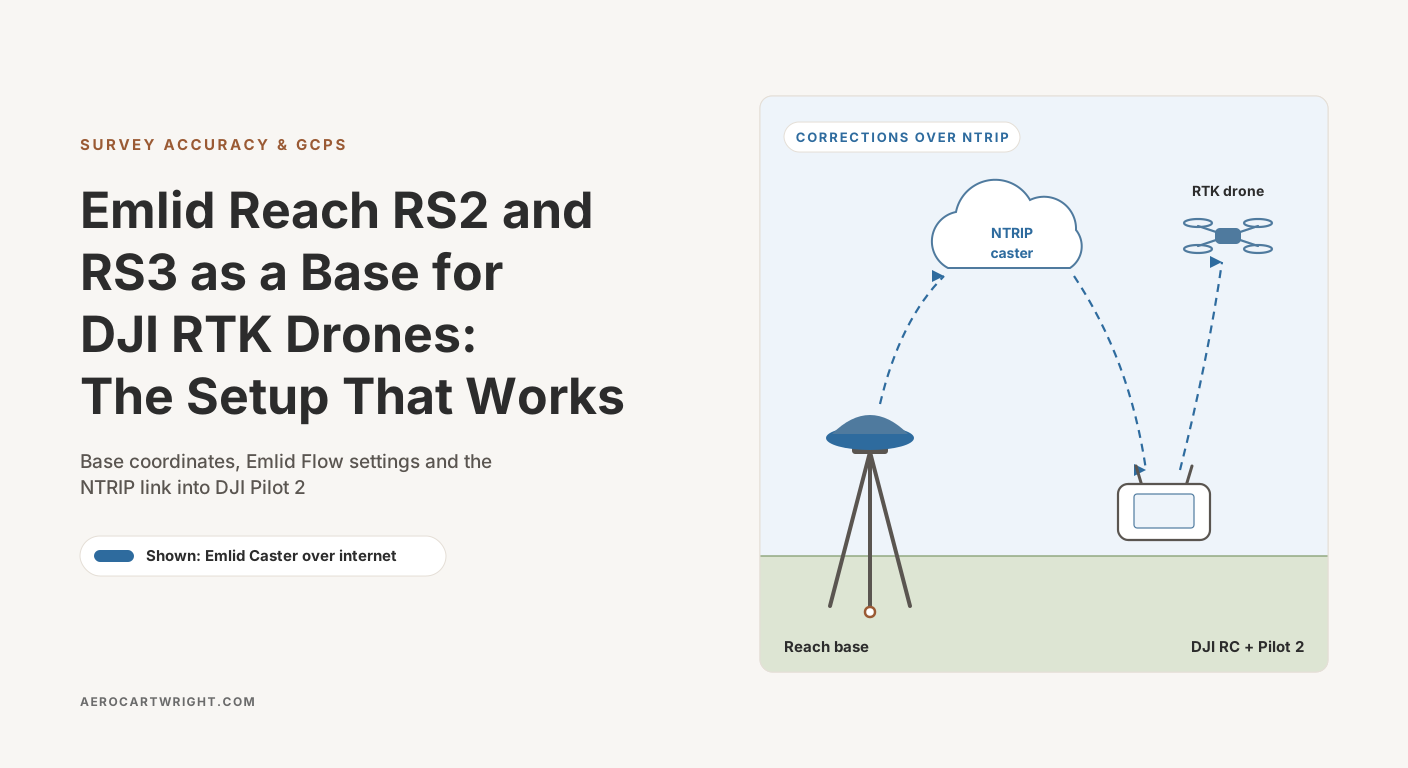
Set up an Emlid Reach base for DJI RTK drones: Emlid Caster and Local NTRIP config, base coordinates, fixed-vs-float troubleshooting, and how it compares with DJI's D-RTK 3.
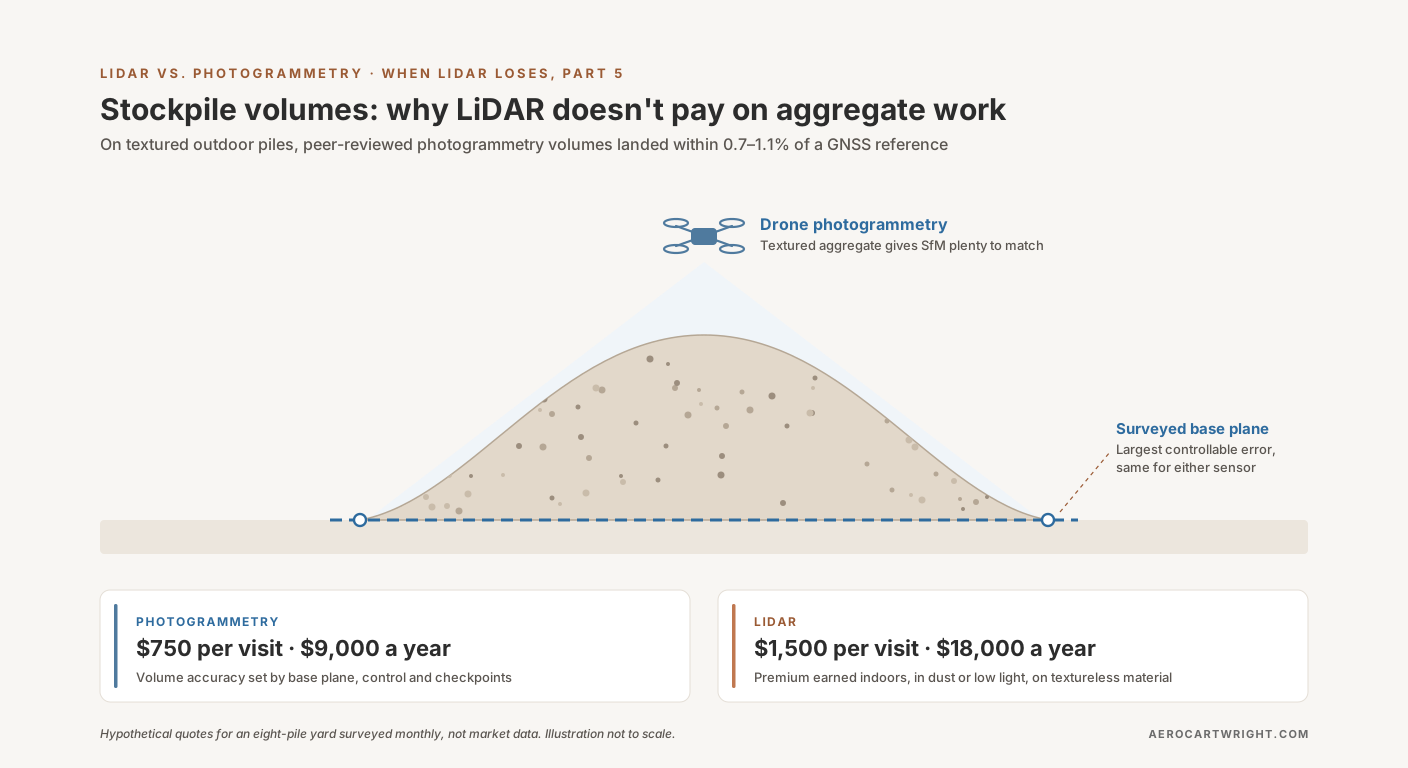
Aggregate stockpiles are textured and outdoor — where peer-reviewed photogrammetry studies landed within 0.7–1.1% of a GNSS reference volume. When the LiDAR premium isn't earning its keep.
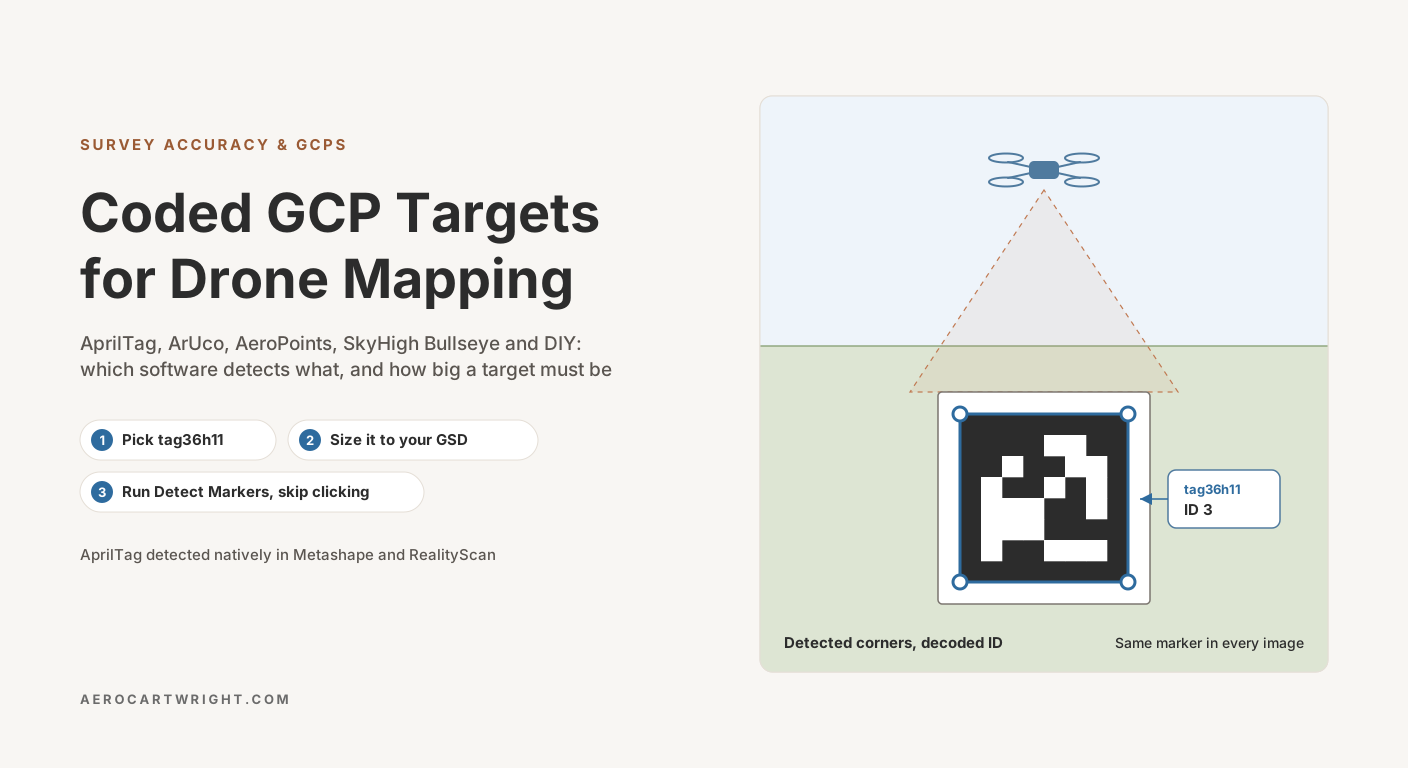
AprilTag GCP targets Metashape and RealityScan auto-detect, the Pix4D and AeroPoint targets Pix4D AutoGCP reads, ArUco vs commercial pads, and target sizing.
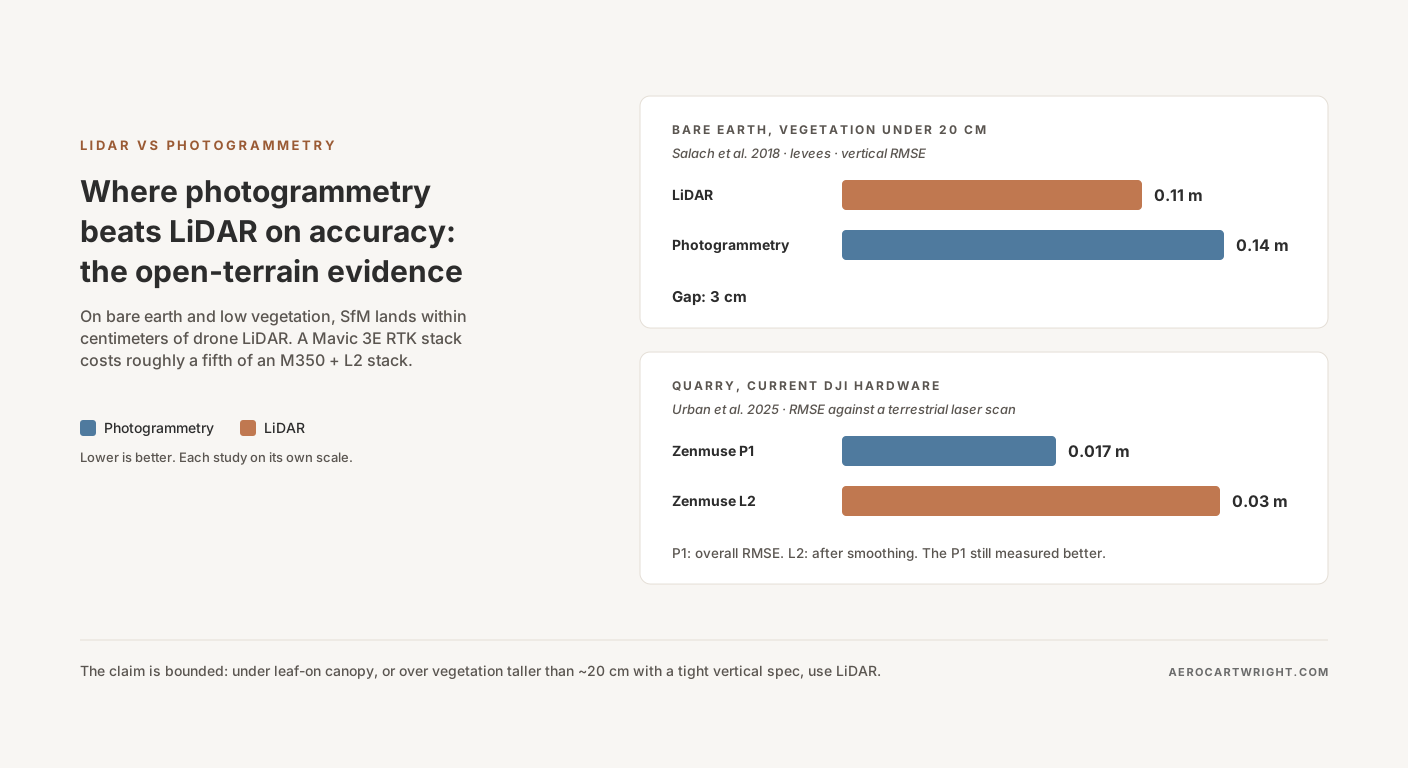
Peer-reviewed studies show SfM photogrammetry landing within a few centimeters of UAV LiDAR vertical accuracy on bare earth, with roughly a fifth of the hardware capex. The studies, the numbers, and where the claim breaks down.
RTK alone produces 2–5 cm horizontal but 5–15 cm vertical bias. Why GCPs still matter, when checkpoint-only works, and the bowling/doming failure mode.
Section 232 drone tariffs took effect Sept. 3, 2026: 25% or 100% on imported drones. What the annexes list, and where RTK/GNSS gear and payloads stand.
Build georeferenced NeRFs from drone imagery: RTK/PPK integration, COLMAP geo-registration, Nerfstudio, point cloud export, checkpoint validation.
Your drone map is a meter low everywhere except around the GCPs. Here is the diagnostic decision tree for vertical bias — and the fixes that actually work.
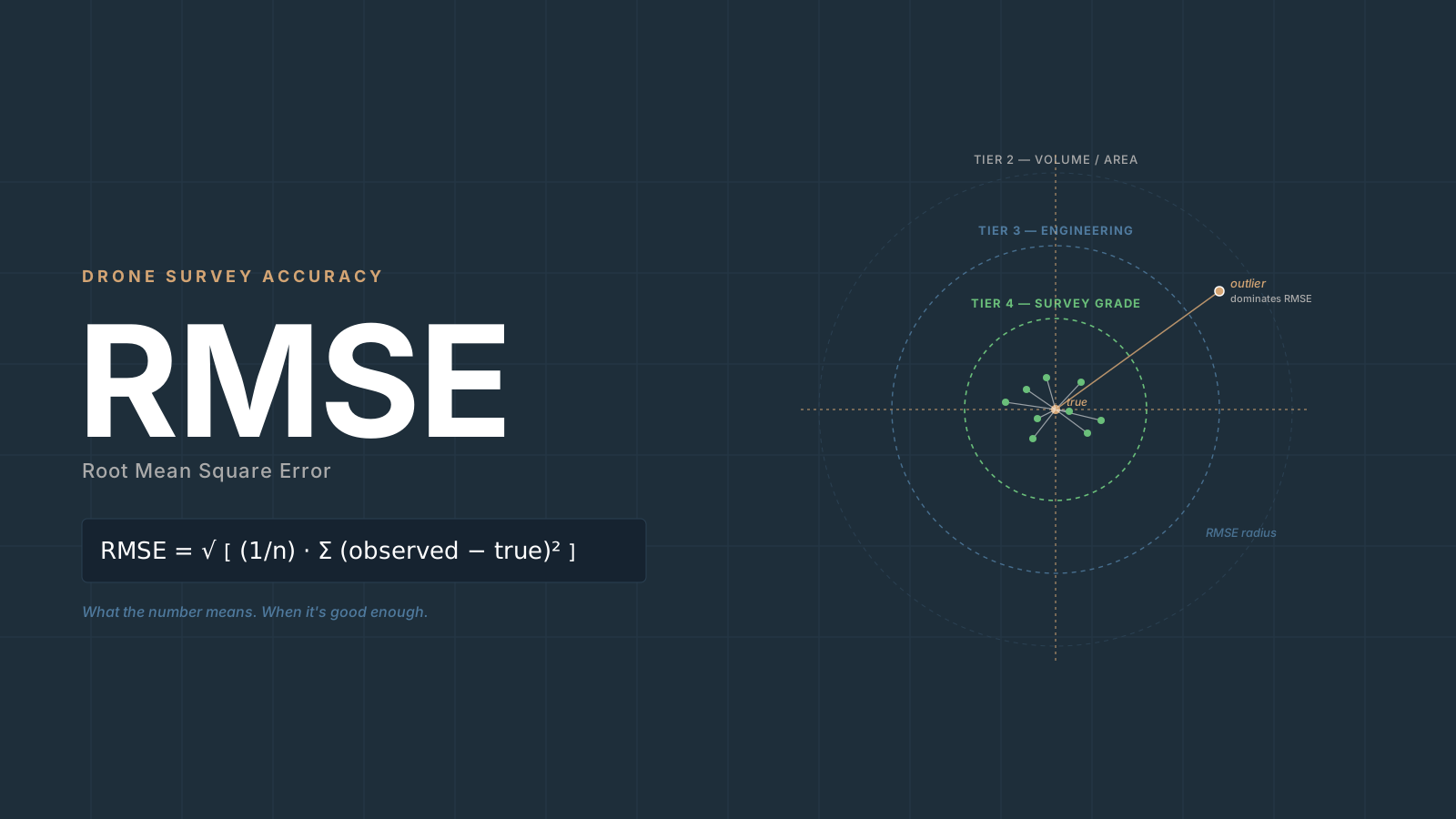
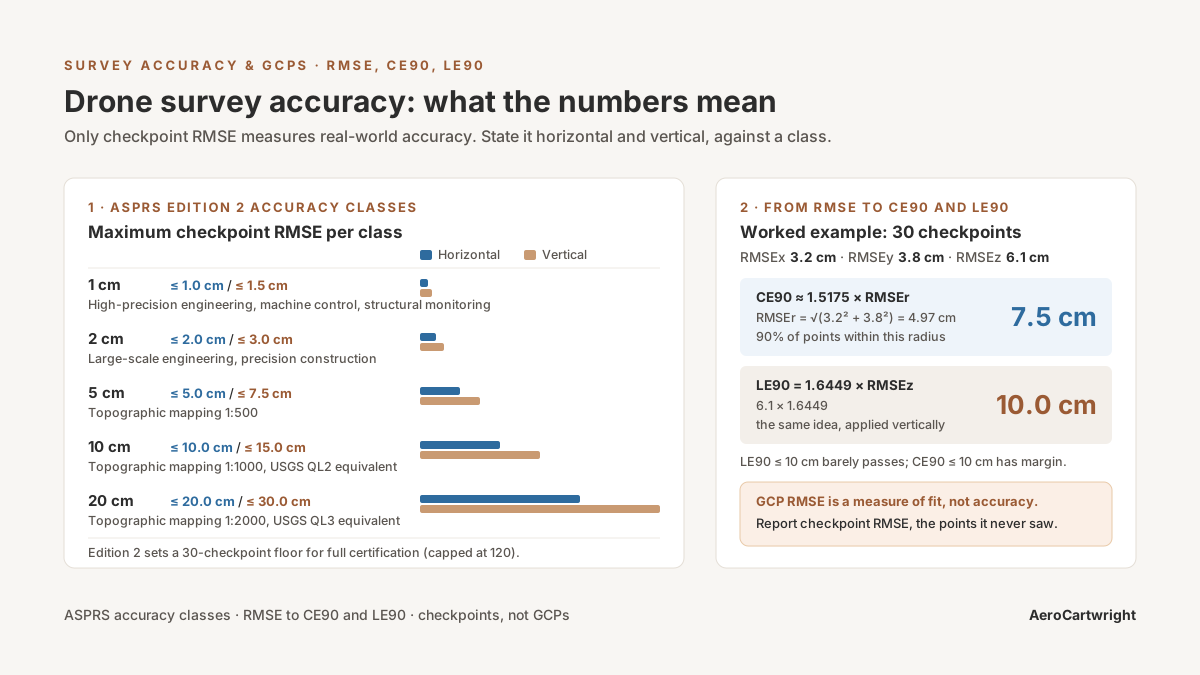
RMSE drone mapping explained: what the formula means, why vertical is always worse, CE90/LE90 conversions, NSSDA statements, when it's good enough.
The drone map doming effect causes systematic elevation errors up to several feet — and the orthomosaic looks fine. Here's how to detect, fix, and prevent it.
The drone mapping quality report looks reassuring — until a client finds 8-inch errors. Learn to read every Pix4D and Metashape number before delivery.
GCP residuals measure fit, not accuracy. Drone survey checkpoints provide independent validation. How to set them up in Pix4D, Metashape, WebODM.
BVLOS for mapping: where proposed Part 108 stands as of November 2026, the waiver process, equipment, PPK workflows, and corridor crew-savings math.
Consumer drone mapping buyer's guide: DJI Mini 4 Pro vs Mini 3 Pro vs Autel Evo Nano+. Accuracy, rolling shutter, GCP needs — field-tested verdicts.
WGS84 vs NAD83, state plane, vertical datums — the CRS settings drone operators get wrong, and how to fix them in Metashape, Pix4D, and ODM.
LiDAR vs photogrammetry for drone surveys: real accuracy numbers, hardware costs, processing workflows, and a decision framework — when each technology wins, and when it doesn't.
Four positioning tiers for drone surveys: GPS, RTK/PPK, GCPs, and full RTK+GCPs+checkpoints. Match accuracy to the job — not every project needs the top tier.
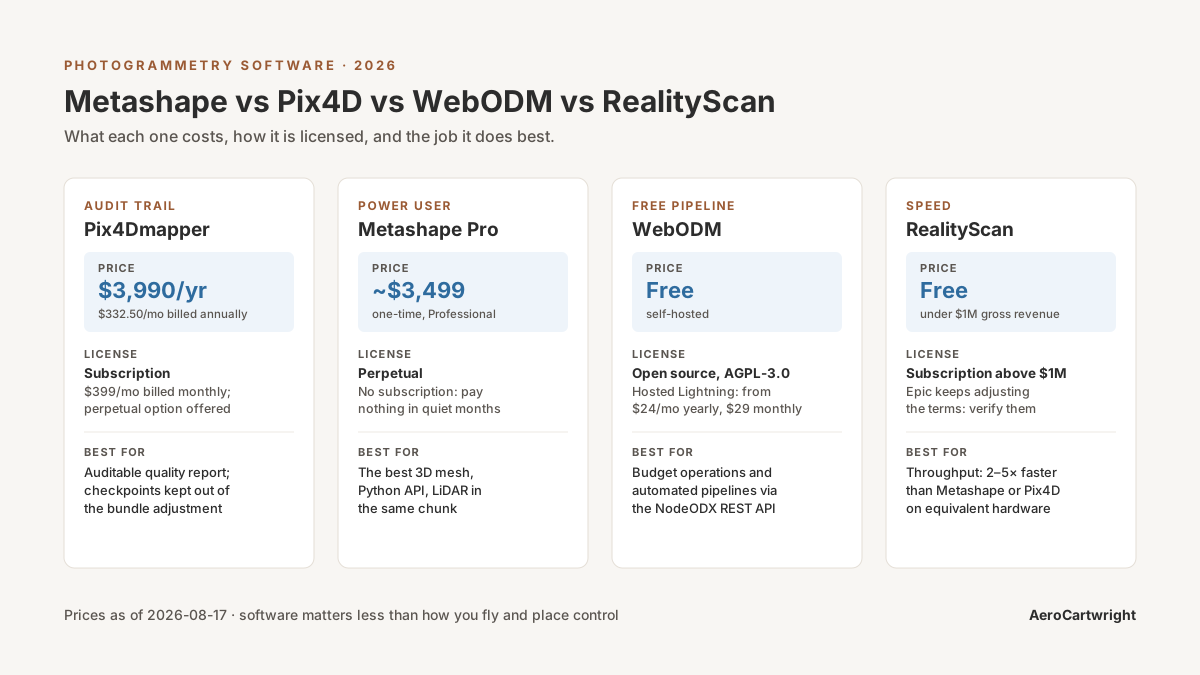
Agisoft Metashape vs Pix4D vs WebODM vs RealityScan (formerly RealityCapture): pricing, speed, accuracy and GCP workflow compared for survey work in 2026.
Drone survey accuracy in 2026: ±2–5 cm horizontal, ±3–12 cm vertical. RMSE vs CE90 (horizontal) vs LE90 (vertical) explained, ASPRS classes, 5 report red flags.
RTK vs PPK for drone mapping: same hardware, different timing. Sourced accuracy figures, baseline limits, costs, and a table for when to use each.
Image-to-model pipelines — overlap, doming, settings, software comparisons, processing settings.
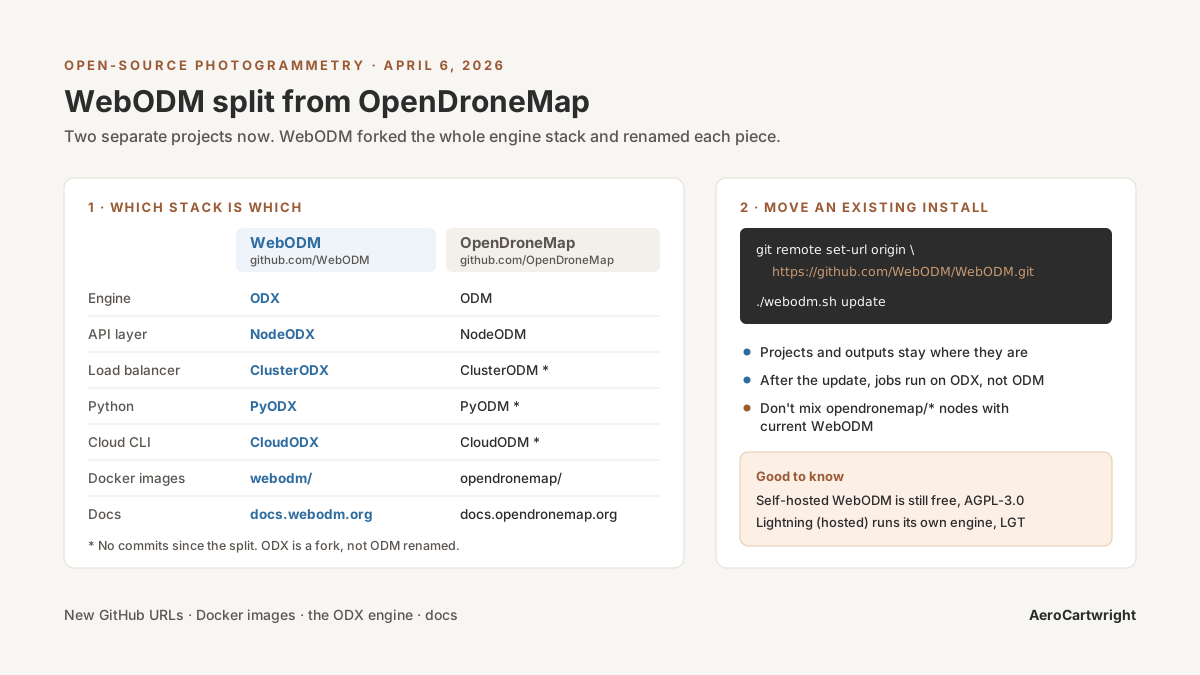
WebODM split from OpenDroneMap on April 6, 2026. What changed and how to migrate: new GitHub URLs, Docker images, the ODX engine, and docs.
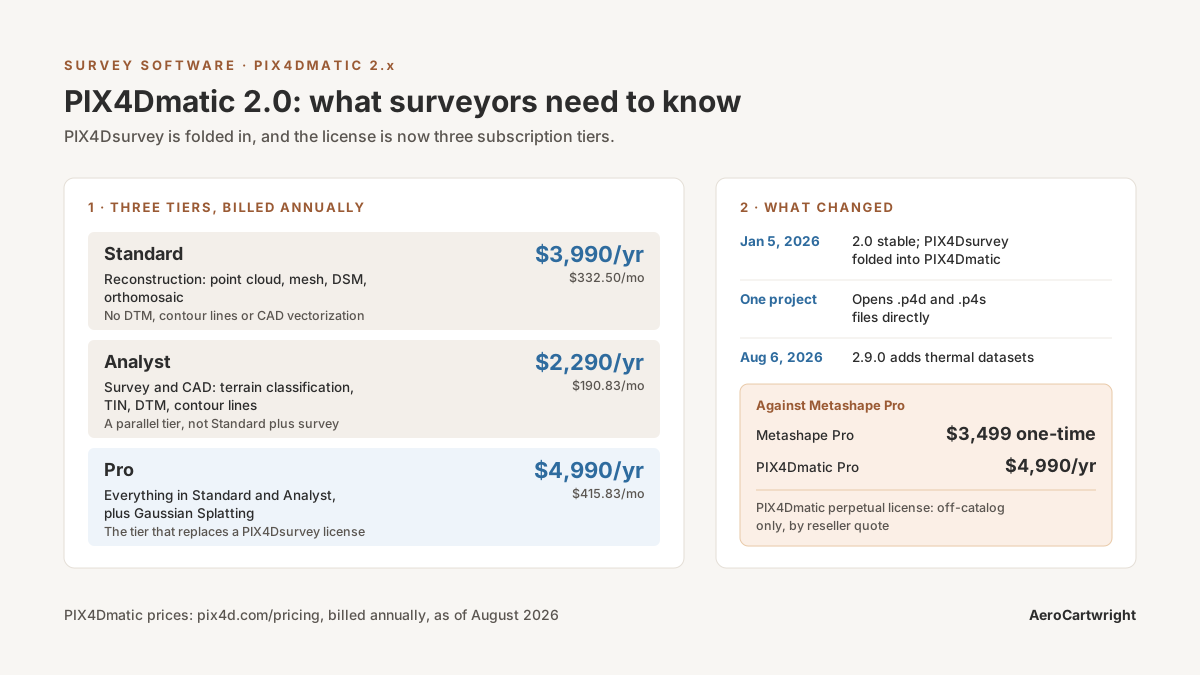
PIX4Dmatic 2.0 absorbs PIX4Dsurvey into three tiers. Full comparison vs Metashape and DJI Terra on price, accuracy, GCP workflows, and deliverables.
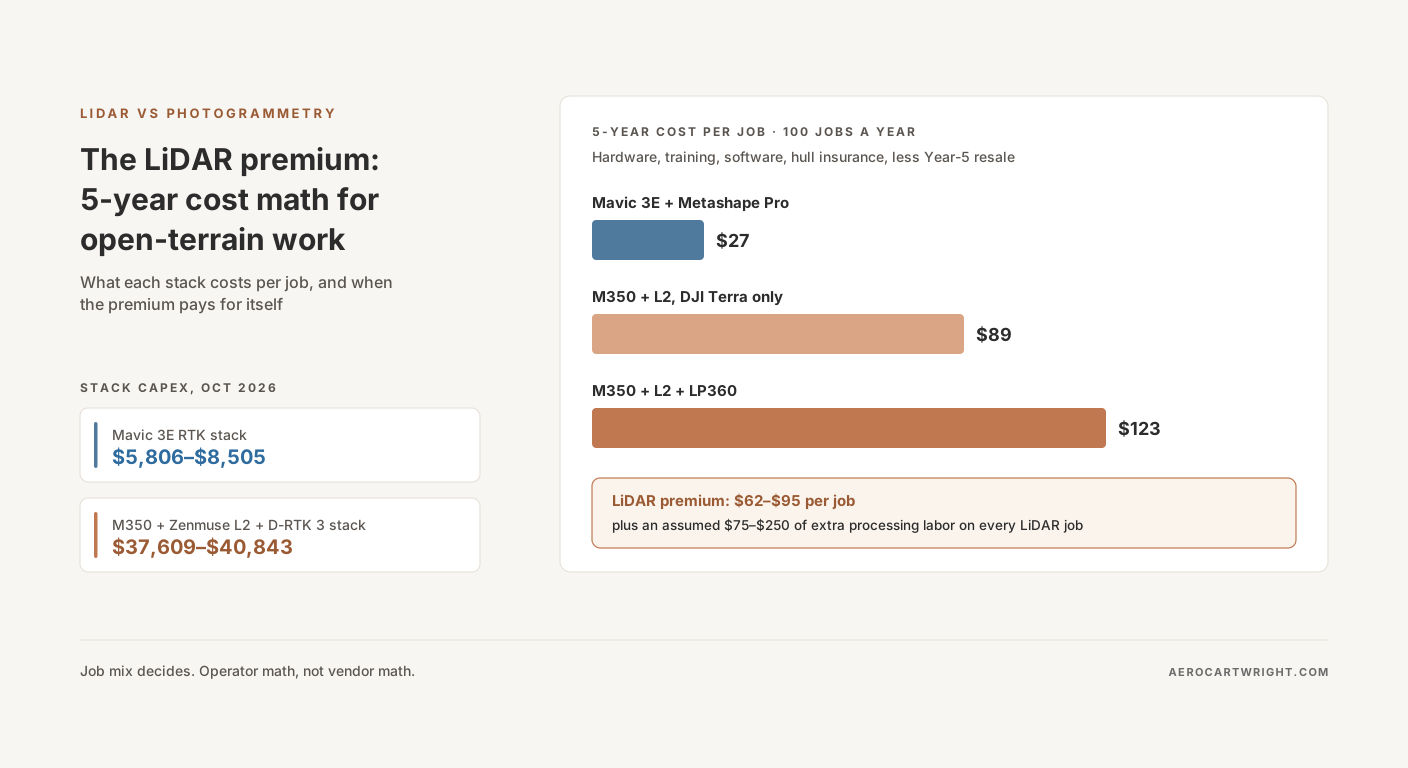
Mavic 3E stack (~$5.8K-8.5K) vs M350+L2 (~$37.6K-40.8K) at October 2026 dealer prices: the per-job cost over 5 years, when the LiDAR premium pays off, and when you're paying for hype.
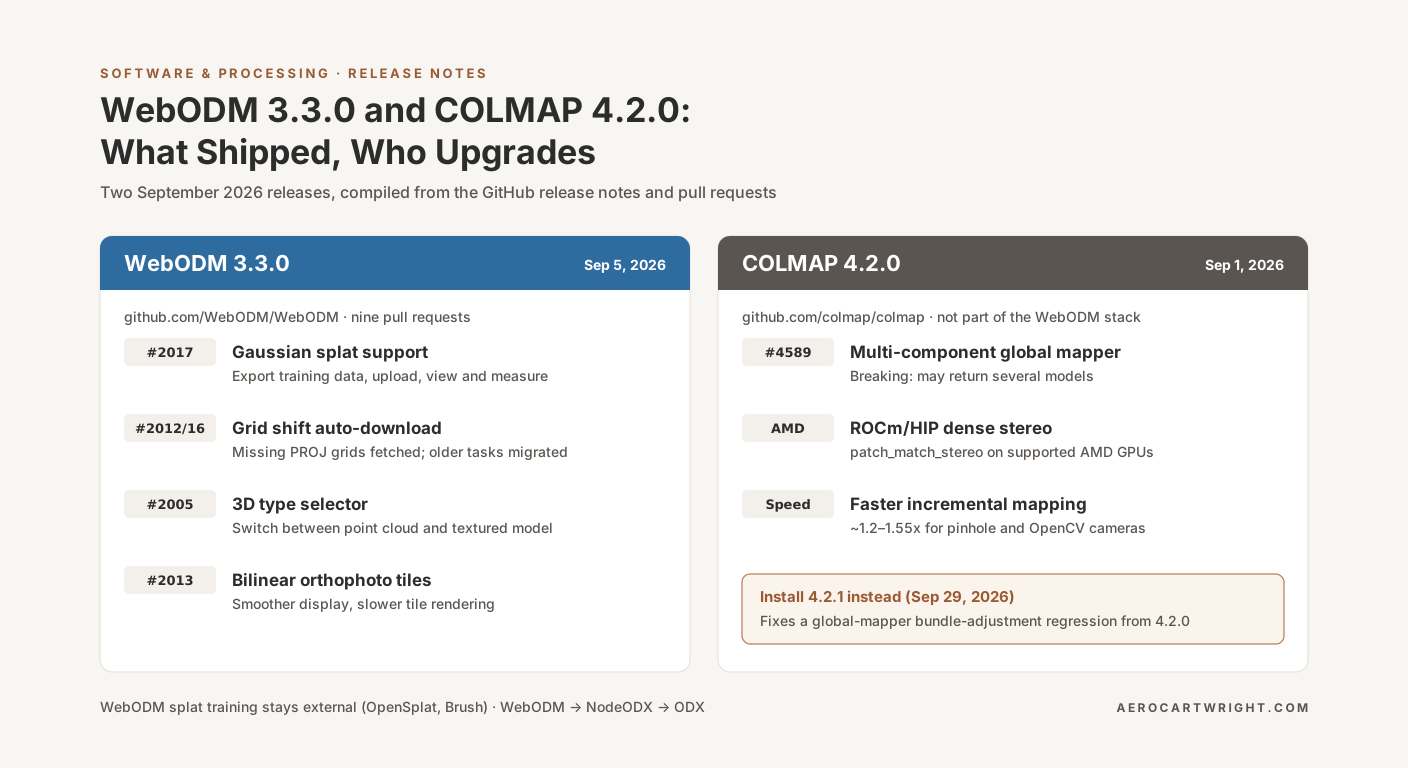
WebODM 3.3.0 adds Gaussian splat viewing and automatic datum grid downloads. COLMAP 4.2.0 reworks the global mapper, and 4.2.1 already patches it.
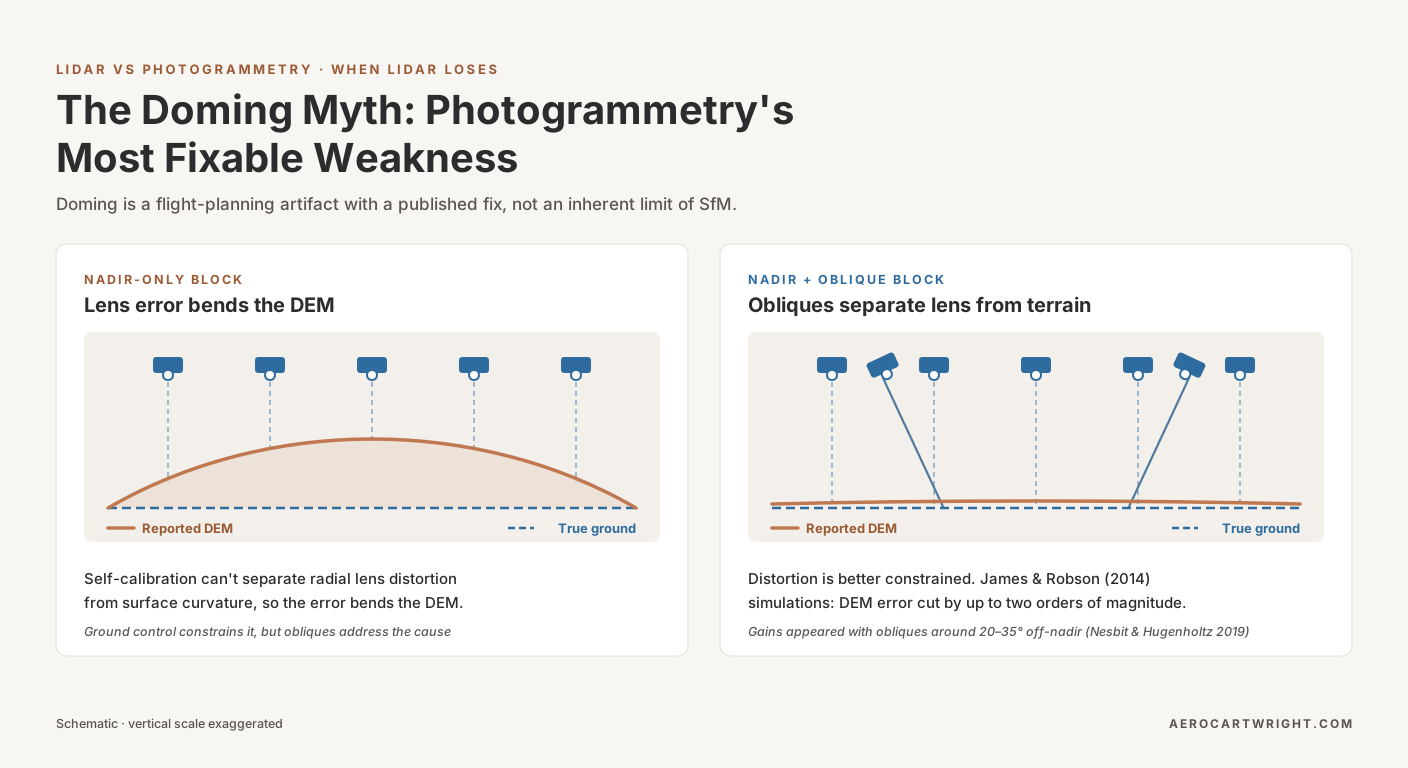
Doming is the textbook anti-photogrammetry argument. James & Robson 2014 and the oblique-imagery fix show it's a planning problem, not an inherent SfM ceiling.
Compare AI point cloud processing tools: Pix4D, Metashape, OpenPointClass. Real accuracy benchmarks, workflows, and which saves time in practice.
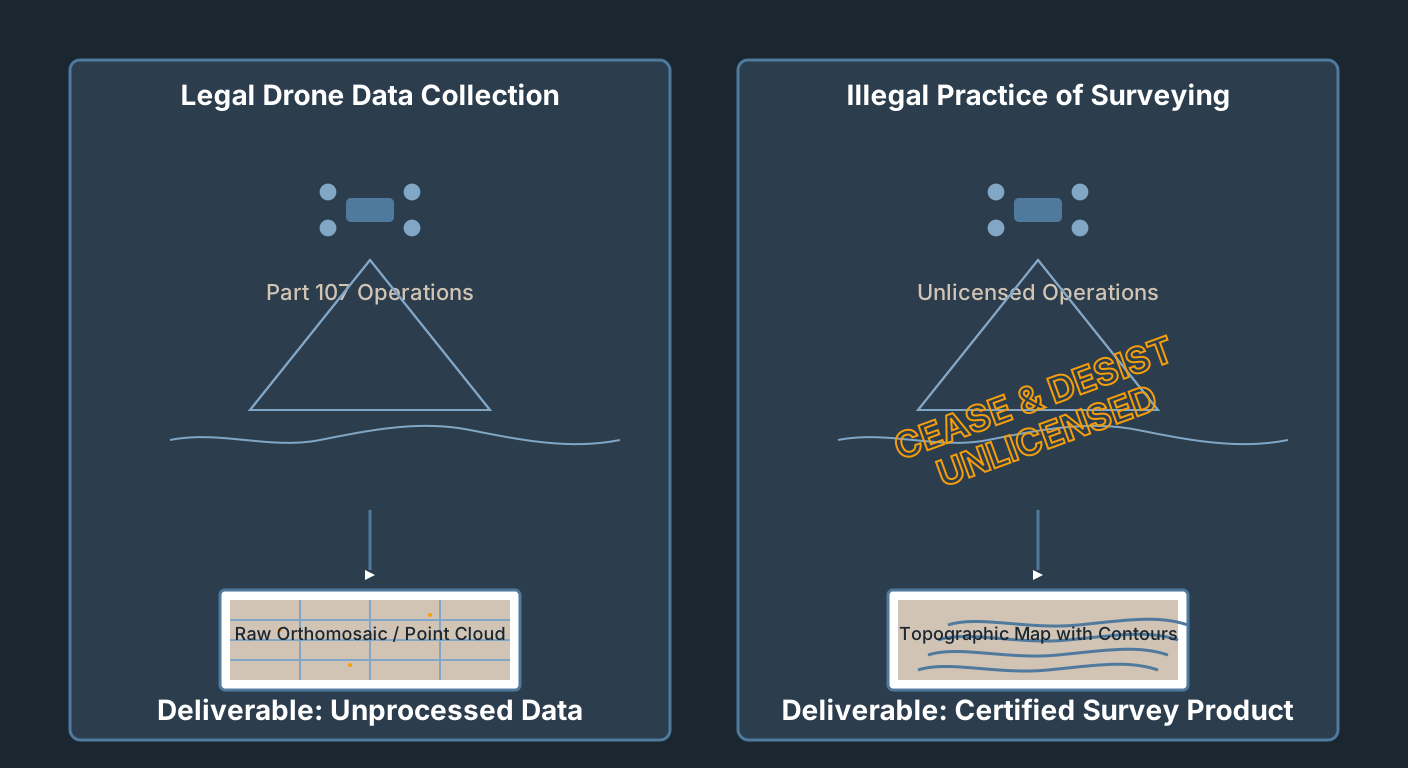
Part 107 authorizes you to fly. It does not authorize you to survey. Where the line is, how states draw it, and how to operate legally in the gray zone.
WebODM 3.2.8 adds DXF export for permanent overlays. OpenDroneMap's ODM 3.6.2 fixes a bug that could silently drop GPS telemetry. Two separate projects, same day: what shipped.
How to pull the bare earth out of a 50-million-point drone photogrammetry cloud. The three tools compared: algorithm, workflow, cost, failure modes, and which one to pick.
Every WebODM/ODX processing parameter explained: feature-quality, pc-quality, matcher-type, mesh-size, SMRF, orthophoto-resolution. Three usable presets.
WebODM install guide for Windows, Mac, Linux: free installers, Docker setup, first task, hardware requirements, common errors. Free photogrammetry on your hardware.
Classify drone point clouds into ground/vegetation/buildings with Metashape, LAStools, PDAL, CloudCompare, ArcGIS Pro. Tool decision framework.
A practitioner's guide to Agisoft Metashape processing settings: what each quality slider controls, why the tradeoffs matter, and three presets for real jobs.
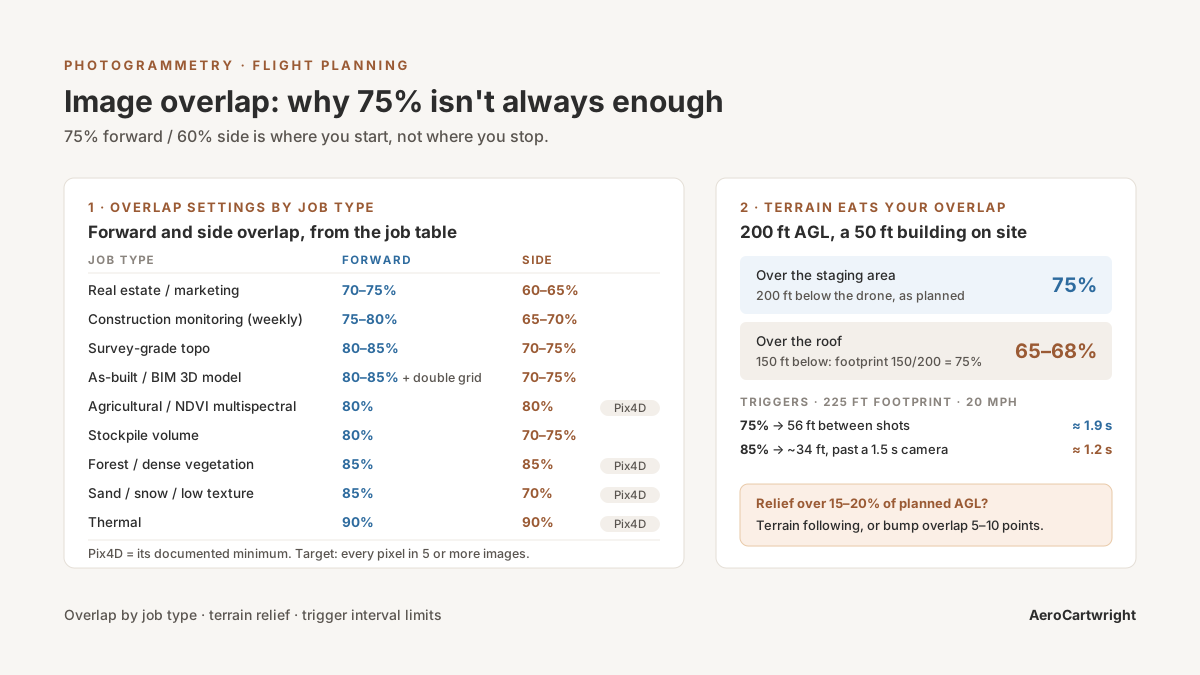
Image overlap drone mapping: 75/60 is the floor, not the target. Here's what fails when overlap is wrong and how to set photogrammetry overlap by job type.
WebODM split from OpenDroneMap in April 2026 and now runs its own forked engine stack: ODX, NodeODX, ClusterODX. Which one you actually install, and what to watch for.
Orthomosaic export settings, point cloud formats, DEMs, coordinate systems — and how to package drone deliverables so clients can actually use them.
Can RealityScan (formerly RealityCapture) run on Linux? Epic's Wine-based CLI build, a script built from Epic's documented commands, and how COLMAP, ODM and Meshroom compare.
Drone data in ArcGIS Pro: import orthomosaics, point clouds, DSMs. Workflow to volume calculations, contours, and ArcGIS Online delivery.
3D Gaussian Splatting for drone operators: vs photogrammetry, accuracy benchmarks, software and pricing, hybrid workflow, what it cannot do.
Digital twin construction contracts can pay $2.5K-15K+/month recurring. The three-tier service model, CRS alignment, platforms, and how to win your first.
WebODM cloud vs local: AWS spot costs (~$2-5/job), egress surprises, decision framework for when cloud wins vs when your workstation is better.
NeRF vs photogrammetry for drone mapping: accuracy numbers, output products, georeferencing limits, and a decision framework for when each wins.
Complete QGIS workflow for drone data: import orthomosaics, build pyramids, contours from DEMs, point clouds, QField field review. QGIS 3.44 LTR.
An orthomosaic is a georeferenced image mosaic built from overlapping drone photos. How photogrammetry creates one, GSD, GeoTIFF vs COG, GIS use.
DSM vs DTM vs DEM for drone operators: definitions, how each is derived from photogrammetry, ground classification, and when each product is required.
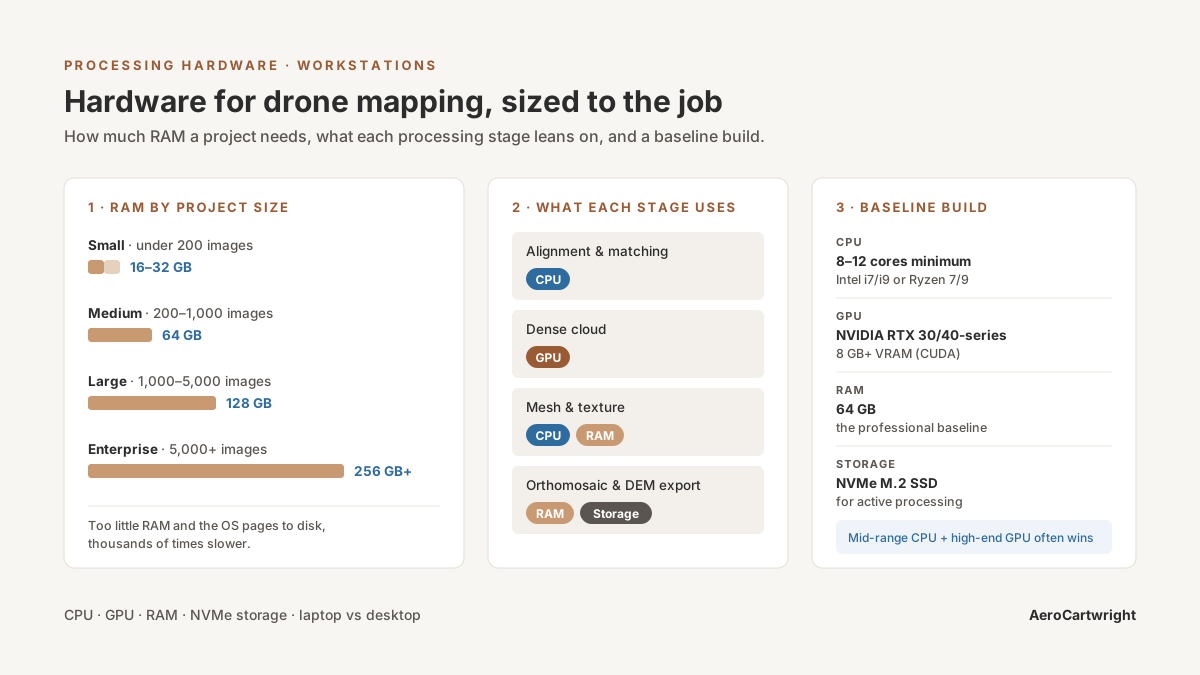
Drone mapping hardware guide: CPU, GPU, RAM, NVMe requirements for photogrammetry. Workstation builds by project size and processing software.
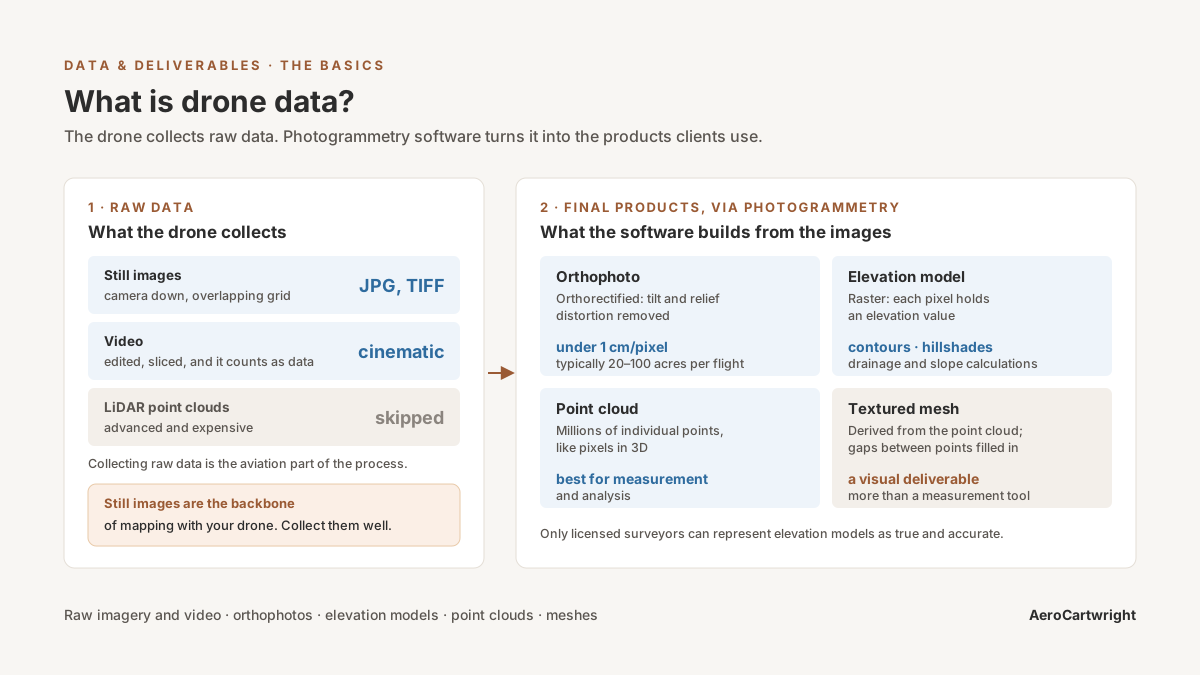
Drone data explained: imagery, orthomosaics, point clouds, elevation models, 3D meshes. How photogrammetry turns photos into geospatial products.
AeroCartwright: drone mapping education and geospatial tools from a working GIS professional with firefighting, academic, and federal field experience.
When LiDAR beats photogrammetry and when it does not. Multispectral, NeRF, Gaussian splatting alternatives.
The FCC's retroactive DJI ban proposal is still undecided; a separate DJI/Autel parts rule starts Oct. 13. What each means for LiDAR rigs and mapping fleets.
Multispectral drones aren't just for crops. Water quality, wildfire, building inspection, mining, forestry — 7 non-ag applications with ROI.
In the field — planning, automation, risk, BVLOS, and what separates professional flight from hobbyist.
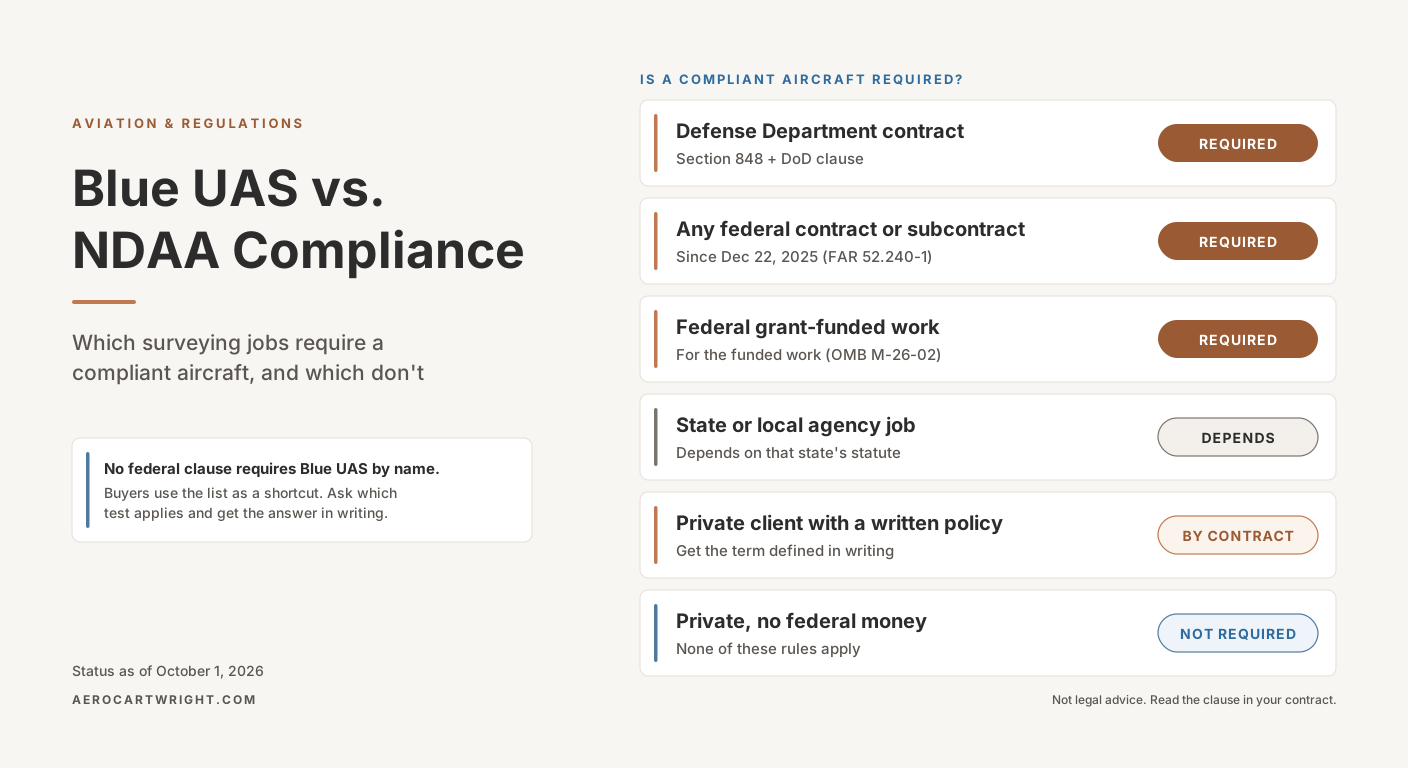
Who needs NDAA-compliant or Blue UAS drones in 2026, what each term legally means, and which mapping aircraft were on the DCMA list on October 1, 2026.
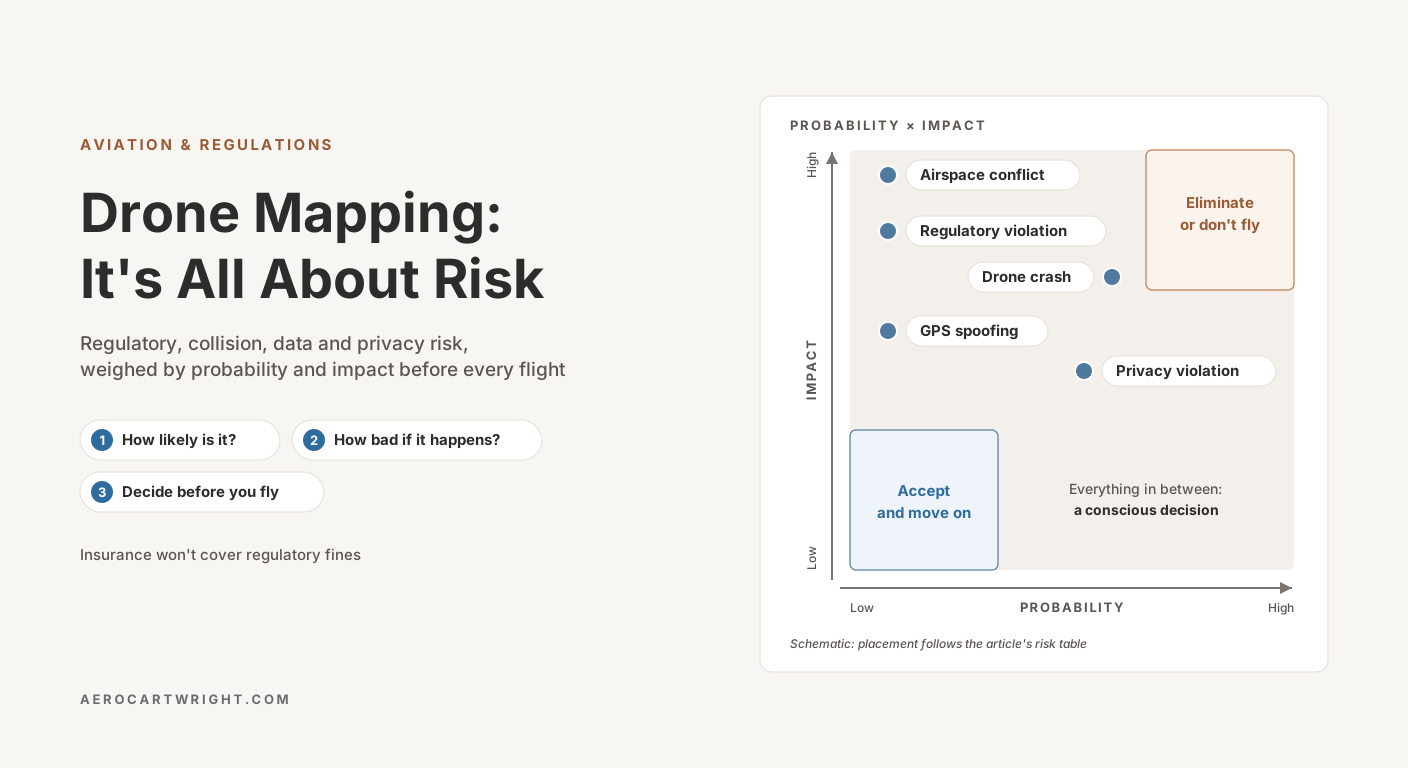
Drone mapping risk framework: regulations, crashes, airspace, privacy, GPS spoofing. Four categories with LAANC, insurance, ADS-B, and checklists.
Your Part 107 certificate puts you in the same FAA system as airline captains. Sectional charts, LAANC, ADS-B In — airspace discipline matters.
Part 107, BVLOS waivers, surveying legality, pricing, packaging, and the business of drone mapping.
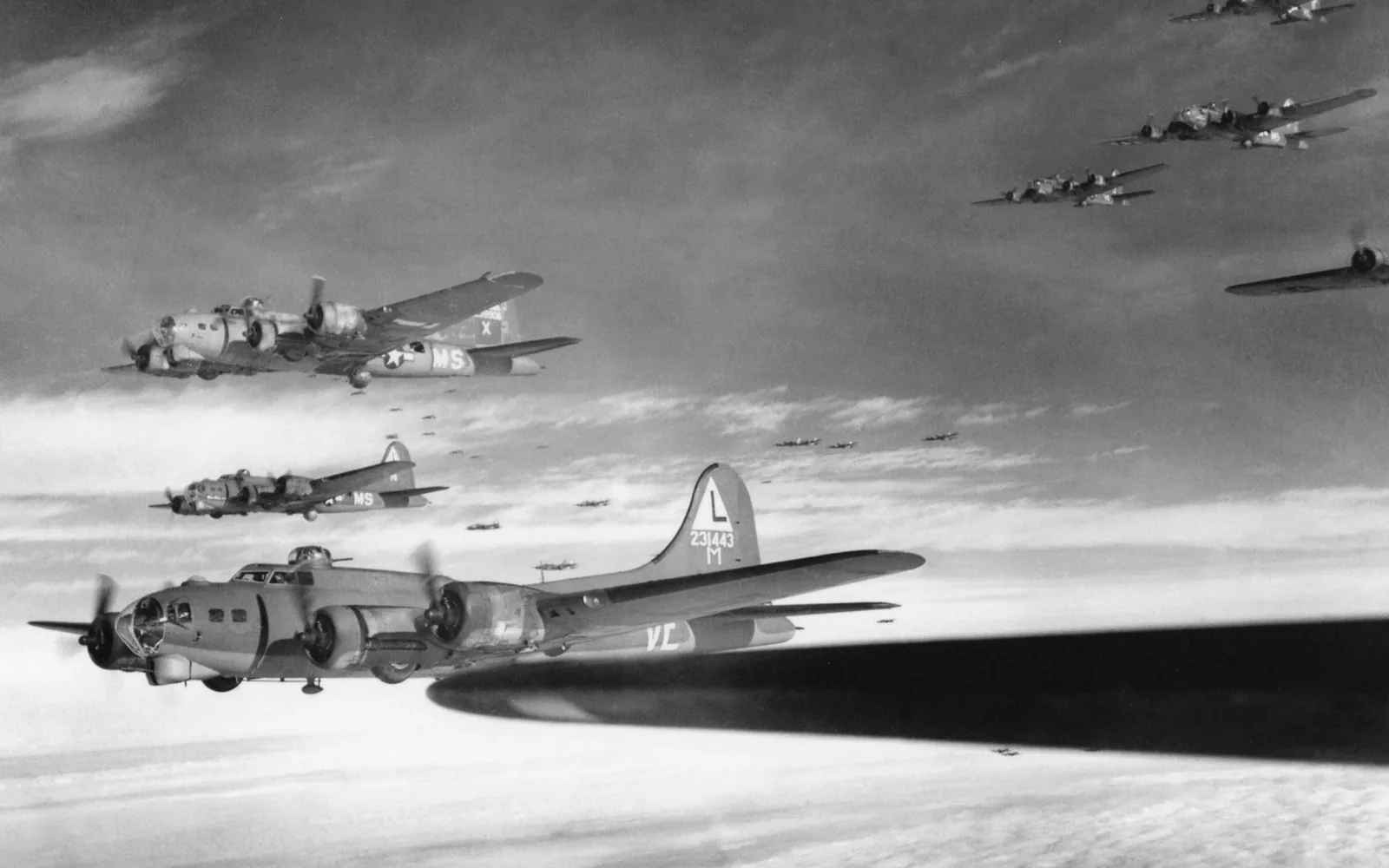
The crew of United Flight 1980 reported a possible drone strike on approach to San Diego International Airport. Here's what the incident reveals about mixed airspace risk and what every Part 107 operator needs to understand.
Tools
Free, embeddable, vendor-neutral. Use during mission planning or to sanity-check a deliverable.
Pillar Guide
30+ pages condensing the entire pipeline — mission planning, field ops, processing, deliverables, QA/QC — into a single field-ready PDF. Free.
Free download: The Complete Drone Mapping Workflow Guide — 30+ pages of field-tested methodology.
Technical content only. Unsubscribe anytime.