
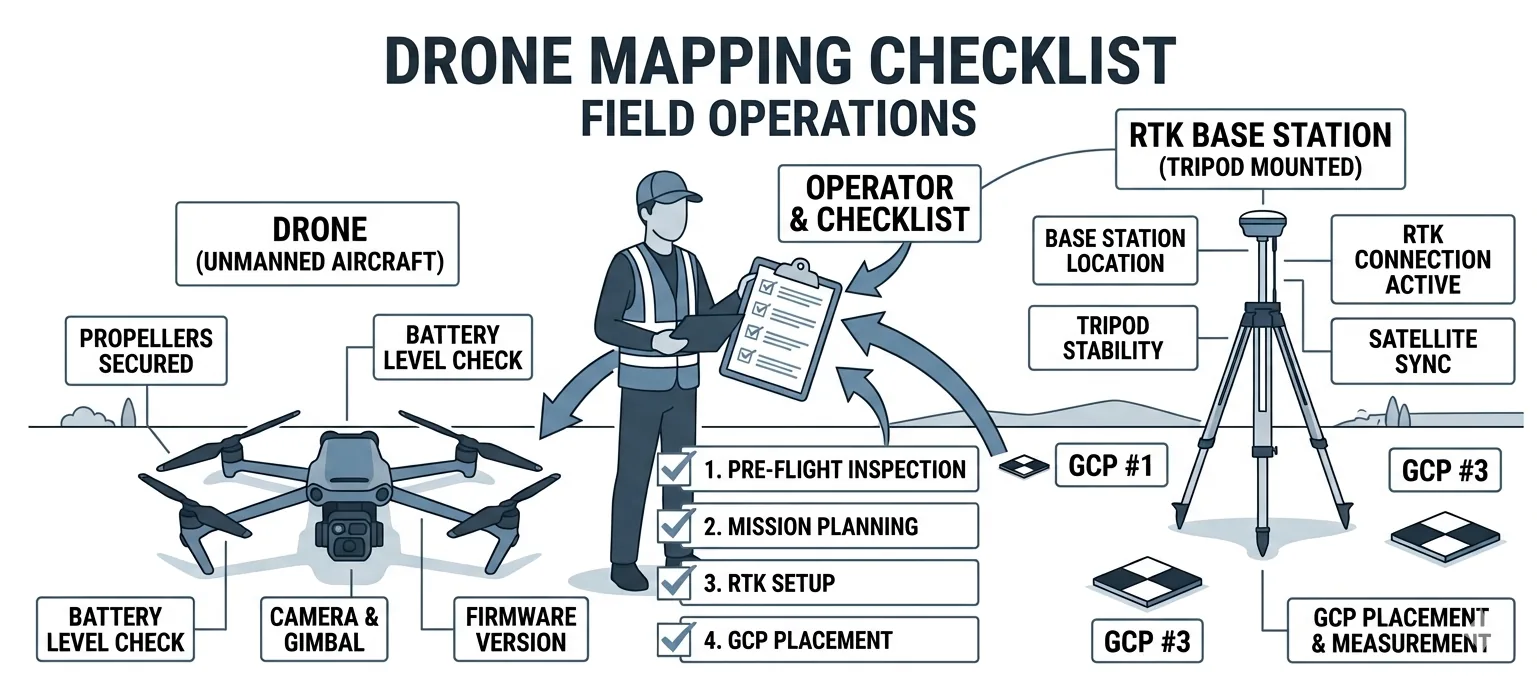
Drone Mapping Checklist Series — every phase from pre-flight planning to deliverable handoff. New articles publish every Friday. This is the series introduction.
The Field Error You Don’t See Coming
You arrive on site at 7:15 AM. The client wants an ortho and contour deliverable for a 40-acre commercial pad site. You’ve flown this type of mission dozens of times. Weather is good. Equipment is charged. You set up your RTK base station, confirm a fixed solution, deploy your GCPs, fly 45 minutes of flight lines at 250 feet AGL with 80/75 overlap, land, swap batteries once, finish the second half, break down the GCPs, pack up, and drive 90 minutes back to the office.
You load the images into your processing software. Align. Bring in the GCP coordinates. Something is wrong. The points are shifting 1,200 feet east and 800 feet north. You check the base station log. The coordinate reference system was still set to NAD83(2011) / State Plane Colorado North from last week’s project. This project spec calls for NAD83(2011) / State Plane Colorado Central. Different zone. Every measurement you took references the wrong projection. Every GCP coordinate is wrong. The entire dataset is unusable.
Cost: a full refly. Crew mobilization — fuel, per diem, equipment wear. A day lost on the schedule. And a phone call to the client’s project manager explaining why the deliverable will be late. That conversation goes exactly as well as you think it does.
Layer in a second scenario. A different operator flies a stockpile inventory at a quarry 3 miles from a regional airport. He’s flown this site before. He “knows” it’s Class G airspace — uncontrolled, no authorization needed. He doesn’t check LAANC. He doesn’t pull up the sectional chart. He launches, flies the mission, and delivers the data.
Two weeks later, a manned aircraft pilot files a near-miss report. The FAA cross-references the drone’s remote ID broadcast with the time and location. Turns out the quarry sits under a Class D surface area extension that was established in a recent airspace reclassification. No LAANC authorization was requested or granted. An enforcement letter arrives three weeks after that.
Both operators are experienced. Both have flown dozens of commercial missions. Neither made an error of competence — they knew the right procedures. They made errors of omission. They skipped a step under field pressure. One forgot to verify a coordinate reference system. The other forgot to verify airspace classification.
This is exactly the class of error that a drone mapping checklist eliminates. Not errors of skill. Errors of skipping.
You’re Already in a Checklist System
In You Are a Professional Pilot. Act Like One, I argued that your Part 107 certificate puts you in the same FAA system as airline captains. Here’s the part I didn’t say: those airline captains don’t rely on memory. They use checklists. Every flight. Every time. Not because they’re incompetent — because they know human cognition fails under operational pressure.
The checklist didn’t start with airlines. It started with a crash.
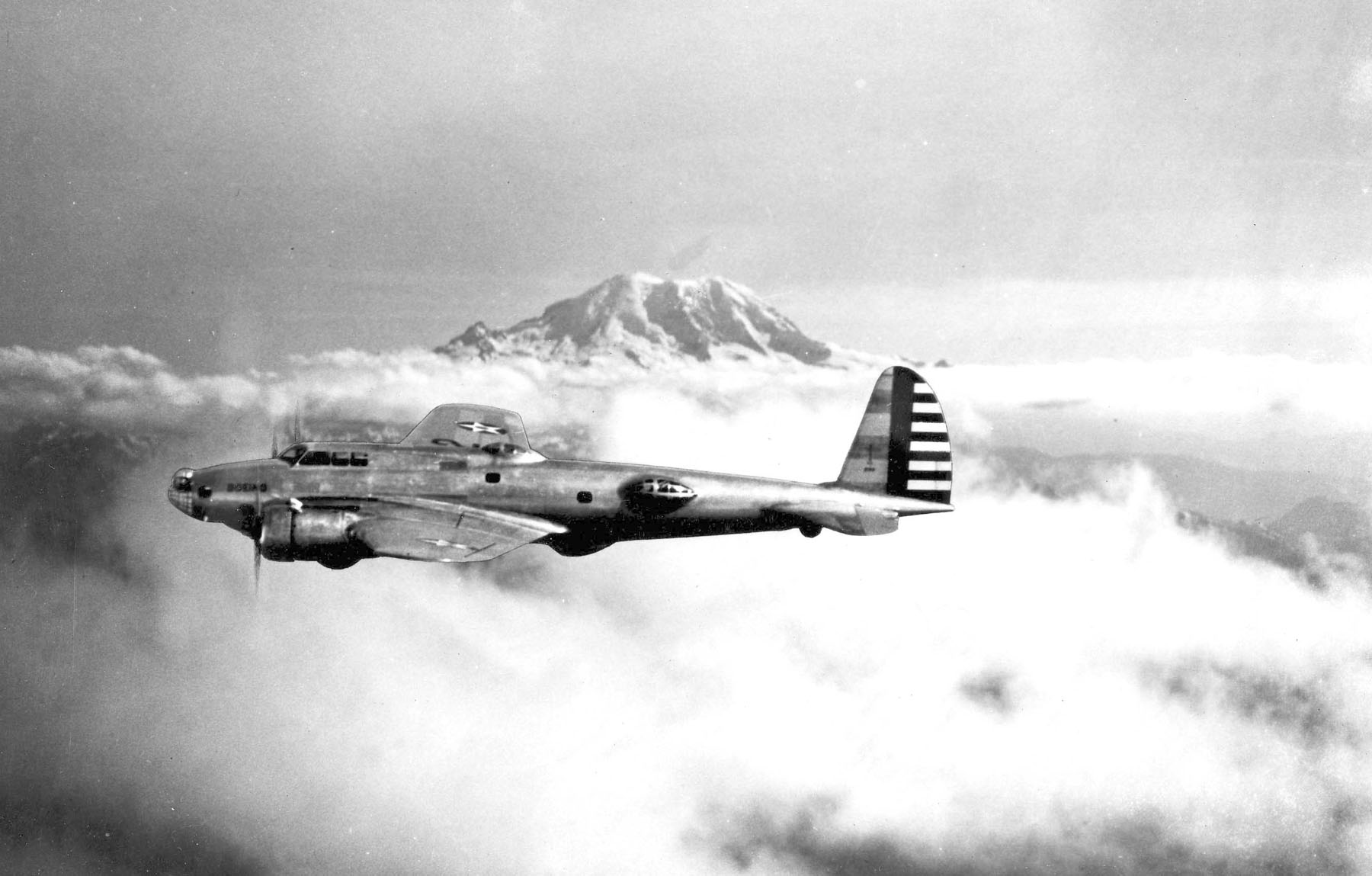
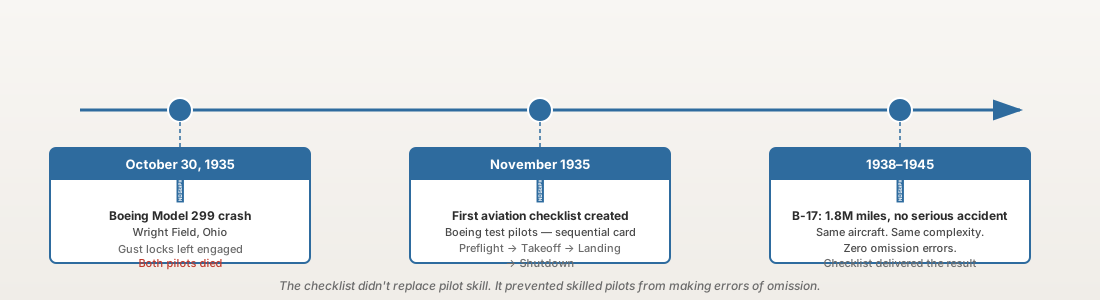
October 30, 1935. Wright Field, Dayton, Ohio. The United States Army Air Corps held a fly-off to evaluate its next-generation long-range bomber. Boeing’s entry — the Model 299, which would later be designated the B-17 Flying Fortress — was the clear frontrunner. It could carry five times the bomb load of the Army’s requirement and fly faster and farther than any competing design.
The evaluation flight was routine. Major Ployer Peter Hill, the Army’s chief test pilot, took the controls. The aircraft taxied, lifted off, climbed to roughly 300 feet — and stalled. It rolled, dove into the ground, and exploded. Hill and Boeing’s chief test pilot, Leslie Tower, both died from their injuries. Two other crew members survived.
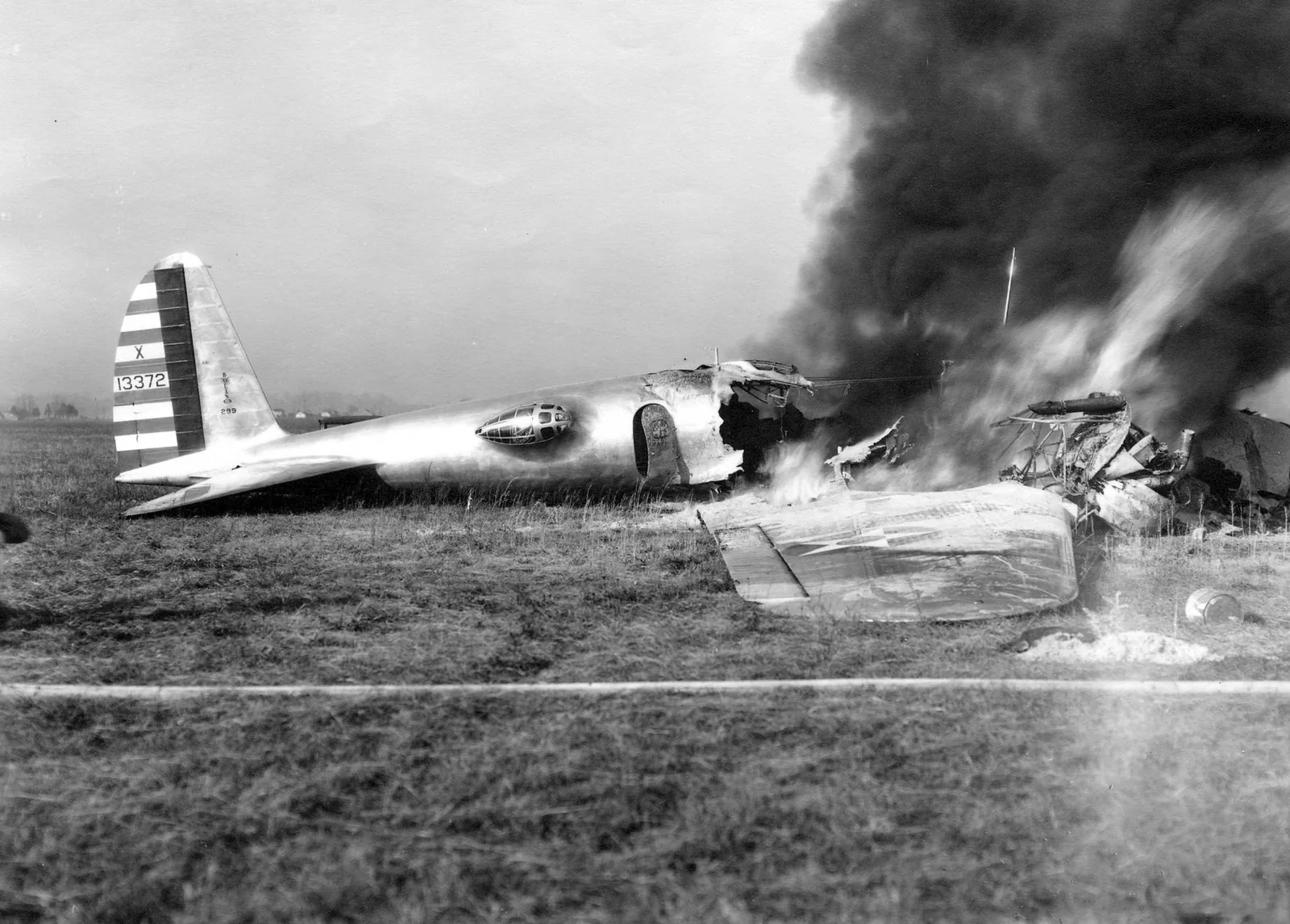
The investigation found no mechanical failure. No design flaw. Major Hill had simply forgotten to release the elevator and rudder gust locks before takeoff — a control surface lock that prevented wind damage while parked. It was a step he had completed hundreds of times. He didn’t forget because he was incompetent. He forgot because the Model 299 was a quantum leap in complexity over anything he’d flown before: four engines, retractable landing gear, variable-pitch propellers, wing flaps, electric trim tabs, and engine cowl flaps — all requiring specific configuration sequences that exceeded what any single pilot could reliably track from memory.
A newspaper reporter at the scene wrote that the Boeing bomber was “too much airplane for one man to fly.”
Boeing’s response wasn’t to simplify the aircraft. They knew the design was sound. Instead, a group of test pilots created something that had never existed in aviation: the pilot’s checklist. A simple, sequential card listing every critical step from preflight through takeoff, flight, landing, and shutdown. Not a training manual. Not a reference guide. A physical list you read and confirm before every phase of every flight.
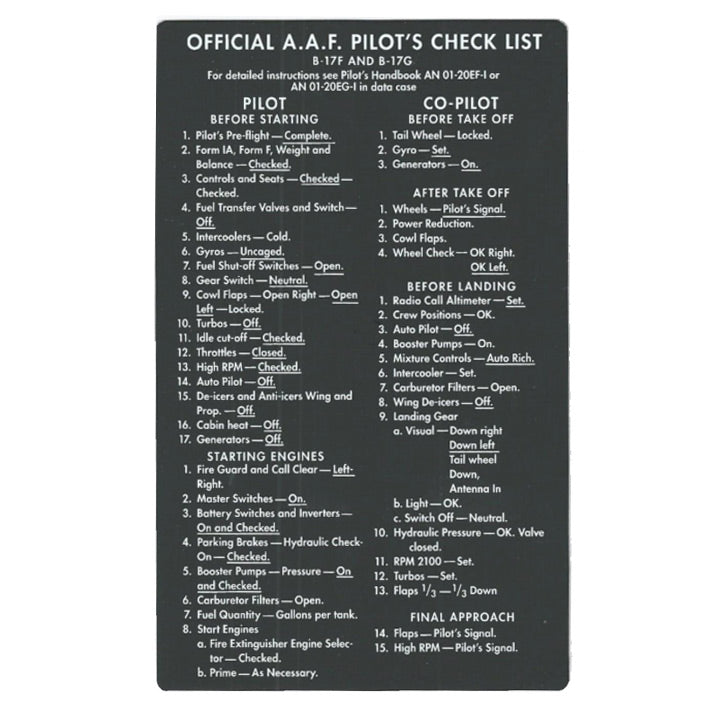
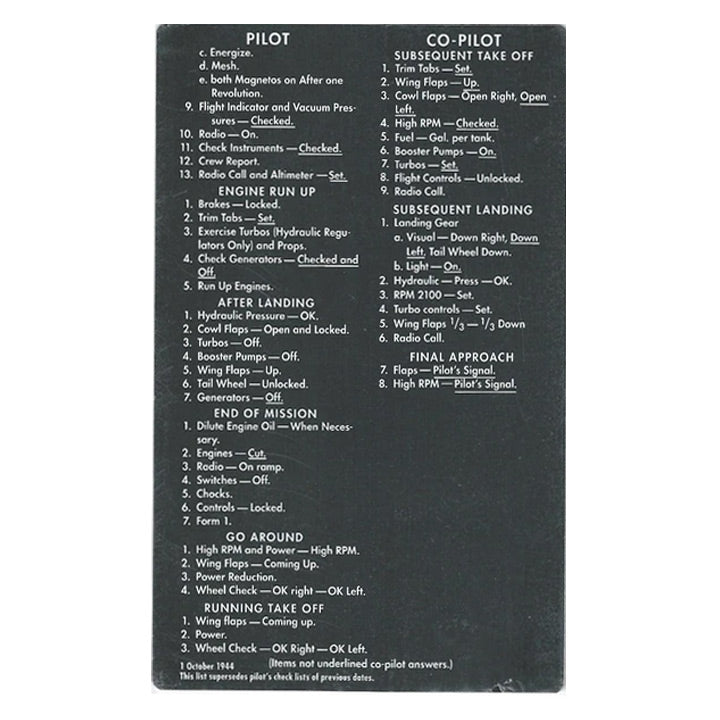
Replica of the official A.A.F. Pilot’s Check List for the Boeing B-17F & B-17G Flying Fortress. (Liberty Aviation Museum)
The result: Boeing delivered the B-17 to the Army Air Corps, and the aircraft went on to fly 1.8 million miles without a serious accident. The same airplane that killed two experienced pilots on its first evaluation flight became one of the most reliable aircraft in military history. The checklist didn’t replace pilot skill. It prevented skilled pilots from making errors of omission.
That same principle applies to every drone mapping mission you fly. Your equipment is complex — RTK base stations, GNSS receivers, flight controllers, camera settings, coordinate reference systems, battery management, airspace authorization systems. Your environment is variable — weather changes, site conditions differ, client specs shift between projects. The number of steps between “arrive on site” and “deliver the final product” is large enough that memory alone will fail you. Not because you lack expertise. Because expertise doesn’t prevent omission under pressure.
Why Memory Fails on Job Sites
Atul Gawande made the definitive case in The Checklist Manifesto (2009). His argument is simple and backed by decades of evidence across medicine, aviation, and construction: human failure falls into two categories.
-
Errors of ignorance — you don’t know the right thing to do. The fix is training, education, experience. You learn the correct procedure, and the error stops.
-
Errors of ineptitude — you know the right thing to do but fail to do it. You have the knowledge. You have the skill. You skip the step anyway — not from carelessness, but from the accumulated cognitive load of managing a complex operation under real-world conditions.
Drone mapping field operations are dominated by errors of ineptitude. You know you should verify the LAANC authorization before launch. You know the coordinate reference system should match the project specification. You know every GCP needs a close-range photo with a scale reference and a wide-angle context shot. You know the SD card should be formatted before the first flight. You know the RTK base station needs 5 minutes of convergence time before you start measuring.
But on a job site with a weather window closing in 90 minutes, a client’s superintendent watching from his truck, two batteries to swap, 14 GCPs to deploy and measure, a pre-flight inspection to complete, a mission plan to verify, and an aircraft to launch — something gets skipped. Not because you’re careless. Because you’re human, and humans managing 47 sequential steps under time pressure will drop one. The question isn’t whether it happens. The question is which step gets dropped and whether it’s the one that invalidates the deliverable.
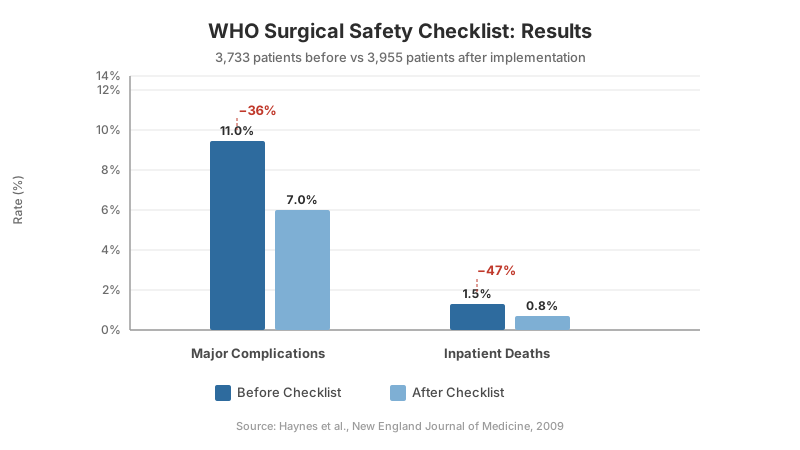
The medical evidence is unambiguous. Haynes et al. (2009) published a landmark study in the New England Journal of Medicine evaluating the World Health Organization’s Surgical Safety Checklist — a 19-item checklist covering patient identification, surgical site verification, antibiotic timing, and equipment counts. The study tracked 3,733 patients at 8 hospitals across 8 countries before checklist implementation and 3,955 patients after. Results: major surgical complications dropped from 11.0% to 7.0% — a 36% reduction. Inpatient deaths dropped from 1.5% to 0.8% — a 47% reduction.
These were experienced surgeons at major hospitals. The checklist didn’t teach them how to operate. It prevented them from skipping steps they already knew — confirming the correct surgical site, verifying antibiotic administration, counting instruments before closing. Steps that every surgeon knows. Steps that get skipped when the OR is running behind schedule and the next patient is already under anesthesia in the adjacent room.
The aviation data tells the same story from a different angle. The NTSB has documented checklist non-compliance as a contributing factor in preventable accidents for decades. The FAA’s Advisory Circular AC 120-71A establishes standard operating procedures — including mandatory checklist use — as a fundamental element of crew resource management. Airlines don’t leave checklist use to individual pilot discretion. It’s required. Every phase. Every flight. The reason is statistical: checklist compliance correlates directly with reduced incident rates across every category of operational error.
The principle transfers directly to drone mapping. A drone survey checklist won’t teach you photogrammetry. It won’t teach you how to set up an RTK base station or design a flight plan. It will prevent you from skipping steps you already know under the specific conditions — time pressure, environmental distractions, equipment complexity, client presence — that cause experienced practitioners to make errors of omission.
That’s the point. Checklists don’t fix incompetence. They protect competence from the conditions that degrade it.
The Six Phases of a Drone Mapping Mission
Every drone mapping mission — regardless of platform, sensor, or deliverable type — moves through six distinct phases. Each phase has its own failure modes. Each phase has steps that, when skipped, create errors that compound downstream. A missed airspace check in Phase 1 creates an FAA enforcement problem. A wrong CRS in Phase 3 creates a deliverable rejection in Phase 6. A coverage gap missed in Phase 4 creates a refly that costs more than the original mission.
The drone mapping workflow checklist for this series breaks the entire operation into these six phases, each with its own dedicated article and downloadable PDF checklist.
| Phase | What It Covers | The Error It Prevents |
|---|---|---|
| 1. Pre-Flight | Site assessment, airspace verification, weather evaluation, equipment inspection, firmware check | Flying in the wrong airspace, launching with uncalibrated equipment, missing a TFR, operating in conditions beyond aircraft limits |
| 2. Mission Planning | Accuracy requirements, GSD calculation, altitude selection, overlap settings, battery budget, flight line design | Wrong resolution for the deliverable spec, insufficient overlap for terrain type, running out of battery mid-flight-line, inefficient flight paths |
| 3. GCP Deployment | Target placement strategy, measurement procedure, coordinate reference system verification, photo documentation, field log | Unmeasured control points, wrong CRS on measurements, targets not visible in imagery, no redundancy on critical points |
| 4. Post-Flight QA | Image review, coverage verification, metadata check, data backup, flight log export | Coverage gaps discovered during processing — the 90-mile refly problem — lost data from single-device storage, missing metadata |
| 5. Processing | CRS configuration, photo alignment QA, GCP integration, dense cloud generation, quality report review, checkpoint analysis | Datum mismatch on deliverable, undetected alignment failures, checkpoint residuals exceeding project spec, unreported accuracy |
| 6. Deliverable Handoff | File format verification, accuracy statement, CRS documentation, projection file inclusion, client communication | Client can’t open files, no accuracy documentation, coordinate system confusion downstream, missing projection definitions |
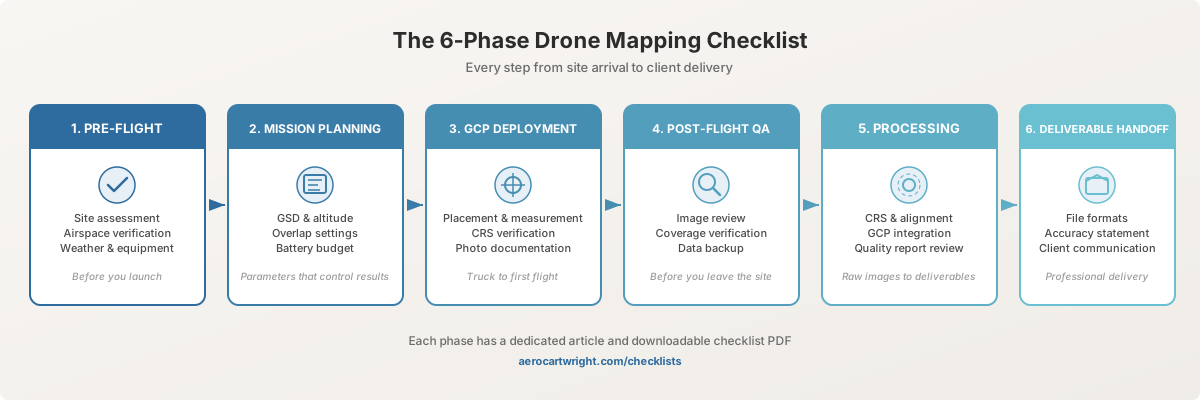
Each phase article in this series walks through every checklist item with the explanation behind it — not just “do this” but “here’s the field failure that happens when you skip it.” The downloadable PDF for each phase is designed to be printed, laminated, and carried on a clipboard in your field kit. The article gives you the why. The checklist gives you the tool.
The sequence matters. Pre-flight verification catches problems that would invalidate everything downstream. Mission planning errors propagate through every subsequent phase. A GCP measurement in the wrong CRS doesn’t surface until processing — hours or days later, when the cost of fixing it has multiplied. Post-flight QA is your last chance to catch coverage gaps before you leave the site. Each phase is a gate. Pass through it with verification, and downstream errors drop. Skip the gate, and you’re gambling that nothing in that phase went wrong.
The UAS field checklist for each phase is deliberately concise. Not a training manual. Not an SOP document. A sequential list of items to verify, short enough to use under field conditions, specific enough to catch the errors that actually happen. The articles provide the depth. The checklists provide the discipline.
How to Use a Checklist
Not all checklists work the same way. Gawande identifies two distinct types, and understanding the difference determines whether your drone mapping checklist actually prevents errors or just collects dust in your gear bag.
Read-Do checklists: You read the item, then perform the action. Step by step, in sequence. This is the checklist as instruction — you use it to guide your actions in real time. When you’re first adopting these checklists, use them in Read-Do mode. Read the item. Do the item. Confirm. Move to the next line. This is slower. It’s supposed to be. You’re building the sequence into your operational pattern.
Do-Confirm checklists: You complete a block of tasks from memory — your normal workflow — then pause at a defined stopping point and run through the checklist to confirm every item was completed. This is the checklist as verification backstop. It’s how airline pilots use most of their checklists after initial training. They don’t read “set flaps to 15 degrees” and then set the flaps. They configure the aircraft from memory, then both pilots run the checklist together to confirm every item. The checklist catches the item that got skipped — the one step that memory dropped.
Start with Read-Do. Move to Do-Confirm once you’ve internalized the workflow. Both modes work. Neither mode works if the checklist stays in your truck.
Here’s the practical guidance that separates a checklist that gets used from one that doesn’t:
-
Print them. Laminate them. Put them on a clipboard in your field kit, right next to your GCP targets and your survey rod. A checklist saved as a PDF on your office laptop doesn’t prevent field errors. A checklist in your hands on the job site does.
-
Run them in order. The sequence exists for a reason. Airspace verification comes before equipment setup because discovering you’re in unauthorized airspace after you’ve deployed 14 GCPs wastes an hour of work. CRS verification comes before GCP measurement because measuring in the wrong datum means measuring again. Each phase builds on the one before it.
-
Do not skip items because you “already know.” This is the single most important point in this entire article. The expert who skips the checklist because they’ve done it a thousand times is the expert who misses the step on attempt 1,001. Gawande documented this pattern across every high-reliability industry he studied — medicine, aviation, construction, finance. The failure mode is always the same: the experienced practitioner decides the checklist is for beginners, stops using it, and eventually makes the exact error the checklist was designed to prevent. Every time.
-
Customize, but deliberately. When you encounter an item that doesn’t apply to your operation — say you don’t use GCPs on certain mission types, or you fly a platform that doesn’t require a specific calibration step — don’t just skip it silently. Note why it doesn’t apply. If it never applies to your operation, remove it from your copy. A checklist that’s too long gets ignored. A checklist tailored to your specific platforms, workflows, and deliverable types gets used on every mission. The goal is a checklist that fits your operation exactly — no wasted items, no missing items.
-
Treat a missed item as a finding, not a failure. If you catch yourself skipping a checklist item, that’s the system working. The checklist exists to catch the skip. Don’t beat yourself up. Don’t rationalize why it didn’t matter this time. Acknowledge it, complete the item, and move on. The value of the checklist is in the catching, not in the perfection.
One more thing. Checklists work best when they’re shared. If you operate with a crew — a visual observer, a GCP team, a pilot and a mission planner — assign checklist responsibilities. The pilot runs the pre-flight checklist. The GCP lead runs the deployment checklist. The pilot and observer jointly confirm post-flight QA. Distributed verification catches more errors than a single operator checking their own work. This is the crew resource management principle that airlines have refined over 40 years, and it applies directly to multi-person drone survey operations.
Bottom Line
Your Part 107 certificate puts you in the same regulatory system as airline captains. Those captains use checklists on every flight — not because regulations require it for every phase, but because decades of accident investigation proved that expertise alone doesn’t prevent errors of omission. Boeing learned this in 1935 when the most advanced bomber in the world crashed because an experienced test pilot forgot a single step. The medical profession learned it in 2009 when a 19-item checklist reduced surgical deaths by 47%. The evidence isn’t ambiguous.
Drone mapping has every characteristic that makes checklists essential in aviation and surgery: complex equipment with dozens of configurable settings, variable environments that change between every mission, time pressure from weather windows and client schedules, and consequences that compound silently when steps are skipped. A wrong CRS doesn’t announce itself on the job site. A coverage gap doesn’t become visible until processing. An airspace violation doesn’t surface until the FAA enforcement letter arrives. These are errors of omission — the exact category that checklists are designed to prevent.
The difference between drone mapping and airline operations is that nobody hands you a checklist when you pass your Part 107 exam. Nobody requires you to use one. Nobody checks.
This series fixes that. Six phases. Six checklists. Every step between arriving on site and delivering the final product to the client. Each article explains the why behind every item. Each downloadable PDF gives you the tool to use in the field.
You already have the expertise. The checklist makes sure you use it — every step, every mission, every time.
Currently published in this series: Pre-Flight Checklist · Mission Planning Checklist. Remaining phases publish on a Friday cadence.
Download the Master Checklist
Get the complete 6-phase drone mapping checklist as a printable PDF. One document covering pre-flight through deliverable handoff — every verification step for a commercial drone survey operation.
Download the Master Checklist →
Subscribe via Buttondown to receive the checklist PDF and get notified as each phase article in the series publishes.